
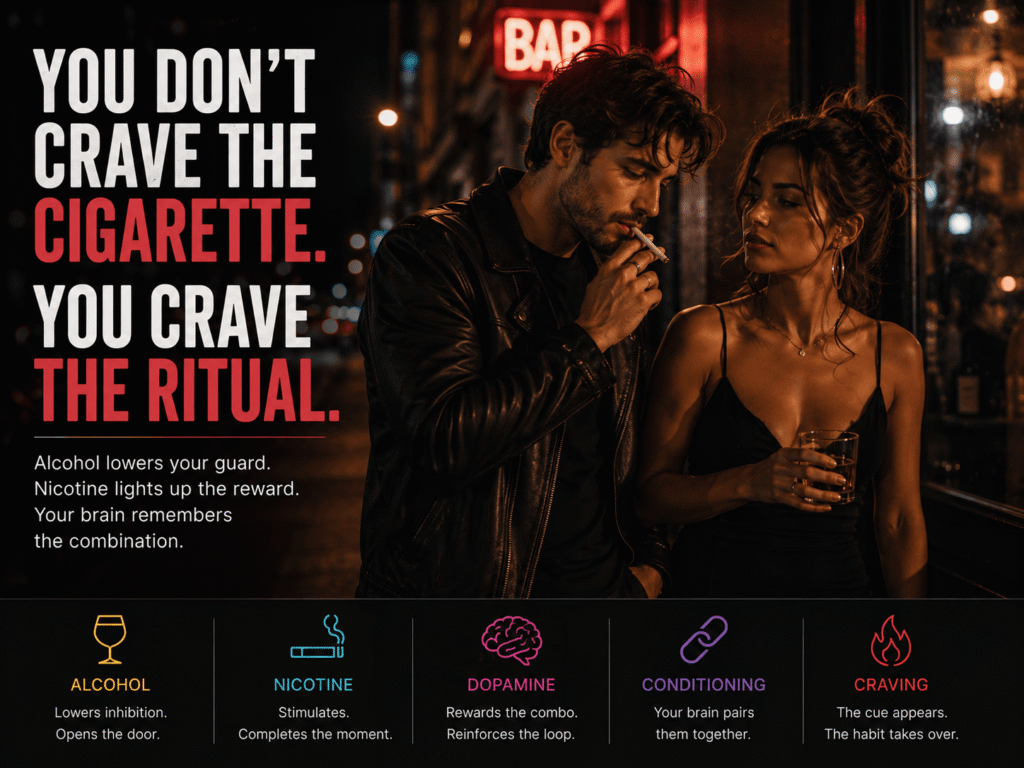
There is a particular kind of craving that seems to arrive with the first few sips.
The drink is cold. The music is louder than it was twenty minutes ago. The conversation has loosened. Someone steps outside, lights a cigarette, and suddenly the thought appears almost automatically:
I want one too.
Sometimes the cigarette even feels different after drinking. Smoother. More satisfying. More necessary. The first drag seems to complete the evening in a way that a cigarette at 11 a.m. never quite does.
That can make people believe alcohol somehow makes smoking more enjoyable.
The reality is more interesting.
Your brain may not be discovering a better cigarette. It may be remembering a better combination.
Alcohol and nicotine are frequently used together, and research suggests the relationship goes beyond simple coincidence. A recent systematic review of adult studies found that alcohol was consistently associated with increased smoking behaviour and smoking relapse, while the relationship also works in the opposite direction in some circumstances. Earlier experimental research has similarly found that alcohol can increase cigarette self-administration and smoking craving.
That means the craving you experience after drinking may not be entirely about the cigarette sitting between your fingers.
It can be about everything your brain has learned to associate with that moment.
The bar.
The friends.
The night.
The music.
The first drink.
The walk outside.
The lighter.
The smoke.
The temporary feeling that tomorrow doesn’t matter yet.
Over time, those elements can become connected.
And once the brain learns a connection, it doesn’t need much convincing to replay it.
The Cigarette Becomes Part of the Ritual
Think about the rituals that surround drinking.
You don’t simply consume alcohol. You choose a place. You meet people. You order something. You settle into a mood. There is often a predictable sequence to the night.
For someone who smokes, the cigarette can become another part of that sequence.
First drink.
Second drink.
Cigarette.
Conversation.
Another drink.
Another cigarette.
Eventually, the brain stops treating these as separate events.
They become one experience.
This is one reason environmental cues matter so much in addiction. Research on cue reactivity shows that people with nicotine or alcohol dependence can develop strong responses to reminders associated with substance use. Those cues can capture attention and trigger craving even before the substance itself is consumed.
So the next time you think, “I only really enjoy cigarettes when I’m drinking,” there is another possibility worth considering.
Maybe your brain has simply learned:
Drinking means smoking.
And smoking means the night has properly begun.
That is conditioning, not necessarily preference.
Alcohol Changes the Moment Before the Cigarette
There is another reason the cigarette can feel unusually satisfying after alcohol.
Alcohol changes how the evening feels.
It can alter mood, attention, social behaviour and perception. Nicotine, meanwhile, has its own stimulating and reinforcing effects. When the two are used together, their subjective effects can interact in complicated ways. Reviews of human laboratory research suggest that alcohol and nicotine can influence each other’s rewarding effects, although the exact interaction varies by person, dose and context.
One particularly interesting finding is that alcohol can increase cigarette self-administration, while nicotine can sometimes reduce aspects of alcohol’s sedating effects. That push and pull may help explain why the two substances so often appear together in the same social rituals.
It can create a strange subjective experience.
Alcohol says:
“Relax.”
Nicotine says:
“Stay switched on.”
And the combination can feel like the perfect middle ground.
Not completely sober.
Not completely sleepy.
Just stimulated enough to keep the night going.
That feeling can become incredibly attractive.
But attraction is not the same thing as benefit.
The brain is very good at learning what feels rewarding without caring whether the reward is good for you in the long run.
That is one of addiction’s most uncomfortable truths.
Dopamine Is Not Your Brain Saying “This Is Good for You”
Dopamine is often reduced to a simple idea: pleasure.
That isn’t quite right.
Dopamine is deeply involved in motivation, reinforcement, learning and the anticipation of rewards. When an experience repeatedly predicts something rewarding, the brain can become increasingly responsive to the cues surrounding that experience.
That matters enormously here.
The drink may become a cue for the cigarette.
The cigarette may become a cue for another drink.
The smell of smoke may remind you of the bar.
The sound of a bottle opening may remind you of the cigarette.
Eventually, you don’t need to consciously decide anything.
The sequence starts running.
Research on alcohol and nicotine co-use has identified overlapping reward mechanisms, including involvement of the mesolimbic dopamine system.
This is why the cigarette can feel almost ceremonial after a few drinks.
You aren’t simply inhaling nicotine.
You are completing a pattern your brain has rehearsed repeatedly.
And repeated patterns can become surprisingly powerful.
Why Smoking After Drinking Can Feel More Satisfying Than Smoking Sober
There is also something psychological happening that has little to do with nicotine itself.
When you’re sober, smoking may feel like a habit.
After drinking, it can feel like a reward.
That difference matters.
During the day, a cigarette may interrupt work. It may happen because the clock says it is time. It may be something you do automatically while standing outside an office or scrolling through your phone.
At night, after drinking, the same cigarette can acquire a completely different meaning.
It becomes part of your freedom.
No meetings.
No deadlines.
No professional version of yourself.
No need to be productive.
Just you, the night, the drink and the cigarette.
That emotional association can make smoking feel much more pleasurable than the nicotine itself would explain.
And this is where SNC’s dopamine lens becomes particularly interesting.
People don’t become attached only to substances.
They become attached to states of mind.
The cigarette becomes shorthand for a particular version of yourself.
The version who stays out late.
The version who takes risks.
The version who talks to strangers.
The version who doesn’t care what tomorrow looks like.
The version who feels slightly rebellious.
That version can be seductive.
Especially when ordinary life feels controlled, repetitive or overmanaged.
Sometimes You Aren’t Craving the Cigarette. You’re Craving the Night
This is perhaps the most revealing question to ask yourself.
If someone handed you a cigarette at 10 a.m. on a Monday, would it feel as exciting?
Probably not.
Remove the alcohol.
Remove the music.
Remove the friends.
Remove the dim lighting.
Remove the anticipation.
Remove the feeling that you have escaped your normal life for a few hours.
Suddenly, the cigarette may not seem nearly as magical.
That doesn’t mean nicotine dependence isn’t real. It is.
It means dependence can become wrapped in layers of emotional and environmental associations.
The cigarette is the object.
The ritual is the experience.
And the experience is what your brain remembers.
This is also why quitting smoking can become more complicated when alcohol remains part of the routine. If every drinking occasion has been paired with cigarettes for years, removing nicotine means breaking more than one habit. You are breaking a network of associations.
A recent review found that alcohol use is consistently linked with increased smoking behaviour and relapse risk, which is one reason treating alcohol and tobacco as completely separate behaviours can miss part of the problem.
That doesn’t mean everyone who drinks is destined to smoke.
It means that for people who already smoke, alcohol can become a particularly powerful trigger.
The Cigarette After the Drink Can Also Be a Social Signal
There is a cultural side to this that is easy to overlook.
Smoking and drinking have spent decades appearing together in films, music videos, nightlife photography and advertising. The cigarette outside the bar became a visual shorthand for rebellion, adulthood, seduction, independence and staying out too late.
Even after advertising restrictions changed the cultural landscape, those images remained.
A person standing outside a club with a cigarette.
Two strangers sharing a lighter.
Friends smoking on a rooftop after midnight.
A couple stepping away from a party for five minutes alone.
These scenes don’t simply sell tobacco.
They sell a mood.
And culture can teach us what certain behaviours are supposed to feel like.
That is why smoking after drinking can sometimes feel almost cinematic.
You’re not only participating in a chemical ritual.
You’re stepping into a familiar cultural script.
The danger is that scripts can feel like personal choices even when we’ve rehearsed them for years.
And Then the Next Morning Arrives
The night rarely feels the same in daylight.
The cigarette that felt perfect at midnight can feel completely ordinary the next afternoon.
That difference is not hypocrisy.
It is context.
Craving is sensitive to cues, surroundings, expectations and emotional states. Research into cue reactivity has shown that alcohol and cigarette-related cues can trigger attention and craving, particularly among people with heavier use or dependence.
So if you are trying to understand your own smoking pattern, don’t only ask:
“How many cigarettes do I smoke?”
Ask:
“When do I most want them?”
Is it after alcohol?
After sex?
After an argument?
At 5 p.m.?
When you’re celebrating?
When you’re lonely?
When you’re with certain friends?
When you finally have nothing left to do?
Those answers can reveal the architecture of the habit.
And once you can see the architecture, the cigarette stops looking like an isolated decision.
It becomes part of a system.
Maybe the Real Addiction Is the Association
There is something strangely powerful about realizing that your brain can turn two unrelated substances into a single ritual.
Alcohol becomes the invitation.
Nicotine becomes the reward.
The night becomes the context.
And eventually, each one starts pulling the others closer.
That doesn’t mean you’re weak.
It means your brain is doing what brains do exceptionally well: learning from repetition.
The more often a particular sequence is rewarded, the easier it becomes to repeat.
The interesting question isn’t whether you “really enjoy” smoking after drinking.
You probably do experience it as enjoyable.
The more useful question is:
What exactly are you enjoying?
The nicotine?
The relief?
The stimulation?
The ritual?
The social atmosphere?
The rebellion?
The feeling of being free for a few hours?
Or simply the fact that your brain has learned that one sensation belongs beside another?
Once you ask that question honestly, the cigarette becomes much more interesting.
And considerably less mysterious.
FAQ
Why do I want to smoke after drinking?
Alcohol and nicotine are frequently paired, and repeated pairing can create strong associations between drinking and smoking. Alcohol can also increase cigarette craving and smoking behaviour in people who already smoke.
Why does smoking feel better after drinking?
Research suggests that alcohol can increase the subjective pleasure associated with smoking. One ecological momentary assessment study found that smokers reported greater pleasure and less perceived punishment from their most recent cigarette when they had consumed alcohol.
Does alcohol increase cigarette cravings?
Yes. Experimental research has found that alcohol can increase urges to smoke, including before exposure to smoking-related cues.
Is there a dopamine connection between alcohol and nicotine?
There is evidence that both substances interact with the brain’s mesolimbic dopamine system, which is involved in reward and reinforcement. Reviews suggest that cross-reinforcement between alcohol and nicotine may contribute to their frequent co-use.
Why do I only crave cigarettes when I drink?
Repeatedly combining alcohol and cigarettes can create conditioned associations. Over time, drinking itself can become a cue that activates expectations and cravings for smoking. Cue reactivity is an important part of understanding both nicotine and alcohol addiction.
Does drinking make quitting smoking harder?
It can. A systematic review found alcohol use was associated with lower smoking-cessation success in most of the studies it examined, and exposure to alcohol cues or drinking itself frequently increased the propensity to smoke.
Sometimes a cigarette isn’t just a cigarette.
It can be a ritual, a reward, a social cue, a memory, or a shortcut to a particular emotional state. Understanding those connections doesn’t make smoking harmless. It gives you a clearer picture of why the craving feels strongest exactly when it does.
Explore more from Sex ‘N’ Cigarette on smoking culture, dopamine, addiction, intimacy, desire, emotional behaviour and the psychology behind the habits we repeat without thinking.
Editorial note: The scientific claims above are supported by research on alcohol and nicotine co-use, cue reactivity, and reciprocal smoking and drinking behaviour. The broader cultural interpretation is an editorial framing rather than a clinical diagnosis.
Recommended Reads:
- Why Does Finishing Inside Her Feel Like the Ultimate Ending?
- Stop Swiping. Your LGBTQ+ Community Is Where Love Happens.
- What the Kamasutra Really Says About Love and Desire
- Why Does Sex Feel Better After Drinking? The Psychology
- The Truth About Anal Sex That Nobody Talks About
- The Pain of Watching Your Ex-Husband Love Someone Else