
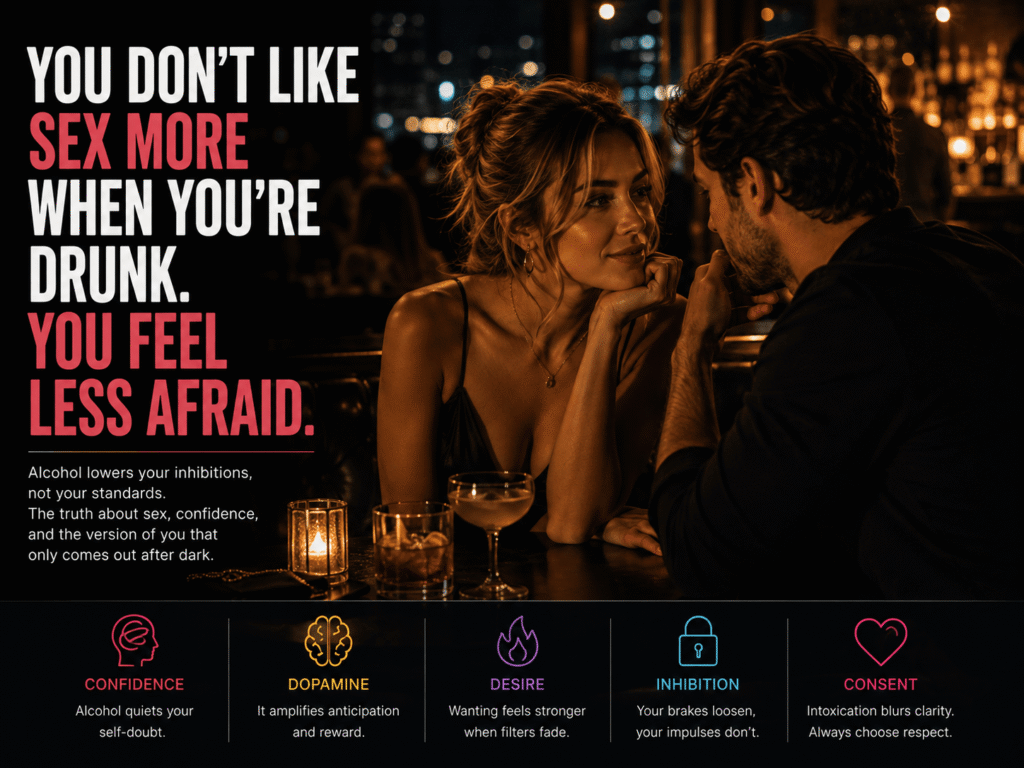
There is a strange moment that happens somewhere between the second drink and the third.
The room feels warmer. The music suddenly sounds better. The person you’ve been noticing all evening becomes more attractive. The awkwardness that normally sits between two people seems to disappear. You become less concerned about how you look, what you’re saying, whether you’re being judged, or whether you are making the “right” move.
And then sex can feel unusually tempting.
Many people describe it as better sex after drinking.
But there is an uncomfortable possibility hiding underneath that feeling.
Maybe alcohol isn’t making sex better.
Maybe it is making you less afraid of sex.
That distinction matters.
Alcohol affects the brain in ways that can reduce inhibition, alter attention, change emotional responses, and weaken the mental brakes that normally make us pause before acting. Research on alcohol and sexual behaviour has repeatedly found links between intoxication, increased sexual risk-taking, changes in perceived arousal, and altered decision-making. Researchers have used concepts such as alcohol myopia and alcohol expectancy to explain why drinking can change how people interpret sexual situations.
So when someone says, “I have better sex when I’m drunk,” they may actually be describing several different experiences happening simultaneously.
There is the physical experience.
There is the psychological experience.
And then there is the version of themselves they temporarily become after a few drinks.
The third one may be the most interesting.
Alcohol Turns Down the Volume on Self-Consciousness
For many people, sex is not difficult because they don’t want it.
It is difficult because they are thinking too much.
Do I look attractive?
Am I taking too long?
What if they don’t like my body?
What if I embarrass myself?
Should I make the first move?
What if they reject me?
Sex requires vulnerability, and vulnerability can make even confident people strangely self-conscious.
Alcohol can temporarily reduce some of those inhibitions.
That can make a person feel more spontaneous, socially confident, and willing to express desire. The experience may feel liberating because the internal commentator has finally become quieter.
This is one reason drinking and sexual situations have become culturally connected for generations.
The drink becomes more than a drink.
It becomes permission.
Permission to flirt.
Permission to touch.
Permission to admit attraction.
Permission to stop worrying about whether you are behaving exactly as you normally would.
But there is a catch.
The same reduction in inhibition that makes someone feel liberated can also make it harder to judge situations accurately.
Alcohol can narrow attention toward the most immediately noticeable cues while reducing attention to consequences and other information. That helps explain why drinking can increase sexual risk-taking even when someone understands those risks while sober. Experimental research and meta-analysis have found alcohol can increase intentions related to unprotected sex, particularly when sexual arousal is already high.
The brain isn’t necessarily saying:
“This is a better sexual experience.”
It may be saying:
“Stop thinking so much and focus on what feels exciting right now.”
Those are very different messages.
Sometimes You Are Attracted to the Version of Yourself Alcohol Creates
There is another layer to the story.
Maybe you don’t actually become more attracted to your partner after drinking.
Maybe you become more comfortable being attracted to them.
That distinction is easy to miss.
A person who is shy while sober may become flirtatious after drinking. Someone who usually waits for the other person to initiate may suddenly make the first move. Someone who constantly worries about their body may temporarily stop monitoring it.
The sexual attraction may have existed all along.
Alcohol simply removed some of the internal resistance surrounding it.
This is where alcohol expectancy becomes fascinating. Research suggests that people’s expectations about what alcohol will do can influence their sexual responses and perceptions. In some experimental studies, simply believing that alcohol had been consumed affected perceived sexual arousal, showing that the psychology surrounding drinking can matter alongside the pharmacological effects of alcohol itself.
In other words, the bottle isn’t doing all the work.
Sometimes your belief about what the bottle allows you to become is doing part of it.
That is a very SNC question.
Because once you remove the alcohol from the equation, another question appears:
What are you giving yourself permission to feel only after drinking?
But Alcohol Doesn’t Actually Make the Body Better at Sex
This is where the popular story starts falling apart.
Alcohol may make someone feel more sexually confident or aroused while simultaneously making some aspects of sexual functioning worse.
That contradiction is well documented.
Research has found that acute alcohol intoxication can affect sexual responses in complicated ways, and higher levels of consumption can interfere with physiological arousal. Studies in men have found reduced erectile response under some intoxicated conditions, while broader research links heavier alcohol use with sexual dysfunction.
Research involving women has also associated alcohol consumption with problems including reduced sexual stimulation, lubrication difficulties, pain, and difficulty reaching orgasm, particularly with higher consumption.
So the romantic idea that alcohol automatically makes sex more passionate is misleading.
It may make the experience feel psychologically easier while making the body’s sexual response less reliable.
And that explains something many people have experienced without understanding it.
You can feel incredibly horny and still struggle physically.
You can want sex intensely and still have difficulty reaching orgasm.
You can feel sexually confident while your body is not cooperating.
Desire and physiological sexual function are related, but they are not identical.
Alcohol can make that separation surprisingly obvious.
Then There Is the Dopamine Trap
Alcohol and sex occupy overlapping territory in the brain’s reward system, but the relationship is more complicated than simply saying “both release dopamine.”
Dopamine is strongly involved in motivation, anticipation, reinforcement, and the pursuit of rewarding experiences. Alcohol can alter reward processing, while sexual cues naturally carry strong motivational significance.
Put the two together and you have a powerful context.
Music.
Flirting.
Physical proximity.
Alcohol.
Anticipation.
Novelty.
The brain begins collecting signals that something rewarding might happen.
That anticipation can become intoxicating in itself.
You may not be chasing sex.
You may be chasing the entire emotional sequence surrounding it.
The confidence.
The attention.
The feeling of being desired.
The sense that something exciting could happen tonight.
This is why someone can wake up the next morning and wonder why the person who seemed irresistible at 1 a.m. suddenly looks completely ordinary at 10 a.m.
The attraction may have been real.
But the psychological environment around it was doing some of the amplification.
The Dangerous Part Is Confusing Disinhibition With Consent
This is where the conversation has to become serious.
Feeling more sexually open after drinking does not mean alcohol creates better consent.
It can actually make consent more complicated.
A recent scoping review of research on alcohol and sexual consent found that alcohol can affect perceptions of consent, internal feelings of desire and arousal, and how consent is communicated. The review also found that intoxication can increase feelings of arousal without necessarily increasing feelings of comfort, safety, or wantedness.
That distinction should never be lost beneath the glamorous image of drunken sex.
Someone can feel excited and still be impaired.
Someone can desire intimacy and still be unable to communicate clearly.
Someone can appear enthusiastic while their ability to make a fully informed decision has been compromised.
Consent is not simply about whether somebody eventually says yes.
It is about whether the people involved are capable of making and communicating that choice freely and meaningfully.
The more intoxicated someone becomes, the more complicated that assessment becomes.
That is why “we were both drunk” should never be treated as a shortcut around the conversation.
Maybe the Better Question Is: What Are You Trying to Escape?
If sex consistently feels better only after drinking, there is something worth examining.
Not because drinking automatically means there is a problem.
But because the pattern may reveal something about sober intimacy.
Maybe you are afraid of rejection.
Maybe you struggle with body confidence.
Maybe you find emotional vulnerability uncomfortable.
Maybe you don’t know how to initiate sex without feeling embarrassed.
Maybe your relationship has become so routine that alcohol provides the novelty you no longer create together.
Or maybe you simply enjoy drinking socially and associate it with relaxed, pleasurable evenings.
Not every drinking-and-sex pattern contains a hidden psychological wound.
Sometimes a drink is just part of a night.
But if you find yourself thinking, “I can’t really enjoy sex unless I’ve had a few drinks,” that is worth paying attention to.
Because the most valuable thing alcohol may have revealed is not how much you enjoy sex.
It may have revealed how much freedom you wish you felt while sober.
That is a much more interesting problem.
And potentially a much more useful one to solve.
The Goal Isn’t to Remove Alcohol From Your Sex Life. It’s to Remove Your Dependence on It
There is nothing inherently profound about being sober.
And there is nothing inherently shameful about enjoying alcohol responsibly.
The point is not to turn intimacy into another wellness checklist.
The point is to notice what happens when the alcohol disappears.
Can you tell your partner what you want?
Can you initiate?
Can you flirt without needing liquid courage?
Can you laugh when something awkward happens?
Can you be naked without mentally inspecting every part of your body?
Can you tell someone you are attracted to them while fully present?
Can you say no just as comfortably as you say yes?
Those are forms of sexual confidence that alcohol cannot permanently provide.
Alcohol can lower the volume.
It cannot teach you what to say when the music stops.
And perhaps that is why some people don’t actually want drunk sex.
They want the version of themselves who finally stops being afraid of wanting sex.
That person is already there.
The interesting question is whether you can learn to meet them sober.
FAQ
Why does sex feel better after drinking?
Alcohol can reduce inhibitions and self-consciousness, which may make some people feel more relaxed and willing to express desire. That does not necessarily mean alcohol improves physiological sexual function.
Does alcohol increase sexual desire?
It can change perceived desire and sexual behaviour, partly through reduced inhibition and expectations about drinking. However, alcohol’s effects vary considerably by person, dose and context.
Does alcohol improve sexual performance?
Not reliably. Higher levels of intoxication can impair physiological sexual functioning, including erectile response and orgasmic function.
Why do I feel more confident sexually after drinking?
Alcohol can reduce self-consciousness and inhibit some of the mental processes that normally make social and sexual situations feel threatening. Expectancies about alcohol can also influence how people perceive their own arousal and behaviour.
Is sex while drunk safe?
Alcohol can increase sexual risk-taking and complicate communication about consent. The more intoxicated someone becomes, the harder it can be to establish clear, freely given consent.
Why am I only sexually confident after drinking?
It may indicate that alcohol is temporarily reducing anxiety, self-consciousness or fear of rejection. Exploring those feelings while sober can help build sexual confidence that does not depend on alcohol.
Sometimes alcohol changes the way sex feels. Sometimes it simply changes the way you feel about yourself before sex. Understanding that difference can reveal a lot about desire, confidence, intimacy, and the emotional habits we carry into the bedroom.
Explore more from Sex ‘N’ Cigarette on modern intimacy, dopamine psychology, sexuality, relationships, attraction, and the strange ways our minds shape what we desire.
Recommended Reads:
- The Truth About Anal Sex That Nobody Talks About
- The Pain of Watching Your Ex-Husband Love Someone Else
- The Best LGBTQ Support Networks for Identity, Family & Wellbeing
- Why Curiosity Makes Cleavage So Attractive
- Can a Misogynist Still Fall in Love?
- What Osho Really Said About Sex, Love and Consciousness