
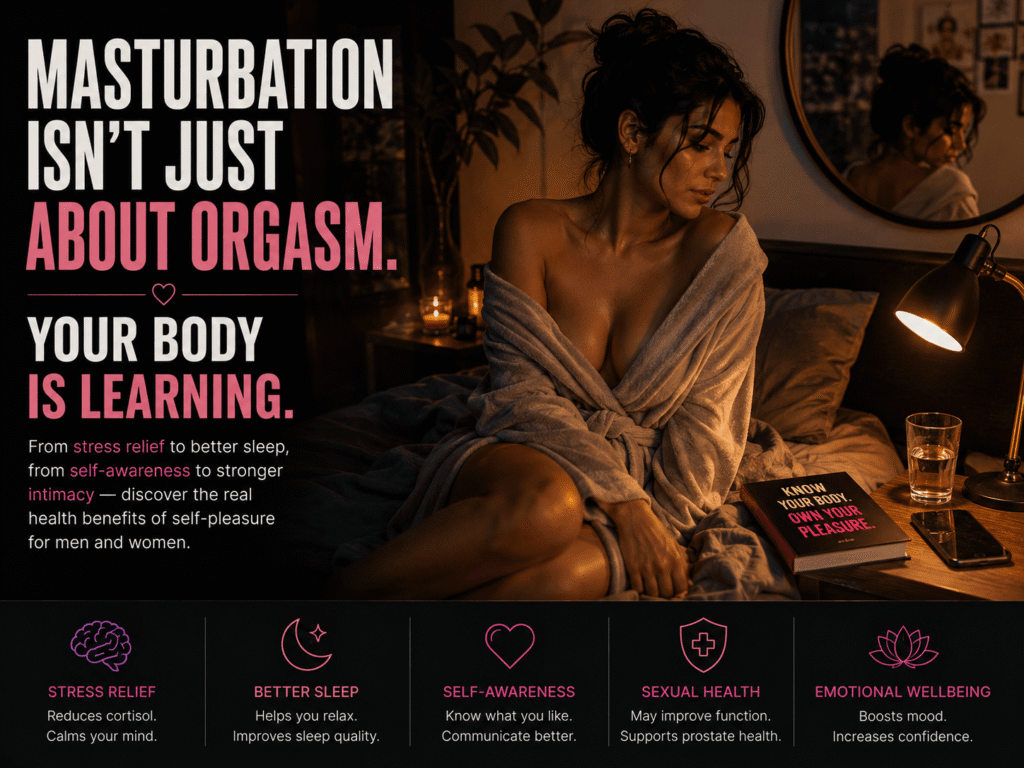
There is something oddly revealing about masturbation.
People do it, think about it, talk about it privately, joke about it with friends, and then often become uncomfortable the moment the conversation becomes serious.
For something so common, masturbation still carries an impressive amount of confusion.
Is it healthy? Is it too frequent? Does it affect sex with a partner? Do men benefit differently from women? Does masturbation actually improve sleep? Does it change libido? Is there a point where self-pleasure becomes too much?
The old SNC article approached masturbation largely as a list of health benefits and a comparison between men and women. It correctly positioned masturbation as a normal form of sexual expression and highlighted stress relief, self-awareness, sexual function and the absence of pregnancy or STI risk from solo masturbation.
But there is a more interesting story underneath all of that.
Masturbation isn’t simply what you do when nobody else is available.
It can be one of the ways you learn what your own body wants.
And that makes the conversation much bigger than orgasm.
Masturbation Isn’t a Substitute for Sex
One of the strangest assumptions surrounding masturbation is that people do it because they cannot have sex.
Single?
Masturbate.
Partner away?
Masturbate.
No relationship?
Masturbate.
The implication is that partnered sex is the real thing and masturbation is the backup plan.
Human sexuality doesn’t work that neatly.
People in satisfying relationships masturbate. People in unhappy relationships masturbate. Single people masturbate. People who have plenty of partnered sex masturbate. Some people rarely masturbate, while others do it frequently, and some simply don’t enjoy it at all.
Planned Parenthood describes masturbation as a normal and personal form of sexual expression and explicitly notes that people in relationships masturbate too.
Research supports the idea that masturbation and partnered sex aren’t simply substitutes for one another. A nationally representative U.S. study found that masturbation could complement an active and pleasurable sex life for some people, while for others it was associated with having less partnered sex or lower sexual satisfaction.
That is a much more interesting picture than “men masturbate more and women masturbate less.”
It suggests that self-pleasure has its own place in a person’s sexual life.
Sometimes it fills a gap.
Sometimes it adds something to an already satisfying sex life.
Sometimes it has almost nothing to do with a partner.
Sometimes it is simply about feeling good.
Your Body Is Not a Relationship Status
This matters because masturbation can become psychologically loaded.
Someone in a relationship may feel guilty about masturbating because they wonder what it says about their partner.
“If I’m satisfied, why do I still want this?”
Someone who is single may feel embarrassed because they think masturbation confirms that they don’t have a sex life.
Someone may worry that their partner’s masturbation means they aren’t attractive enough.
None of those conclusions automatically follows.
Masturbation is an individual sexual behaviour.
It can exist alongside attraction, love, commitment and partnered intimacy.
In fact, learning what feels pleasurable can sometimes make communication with a partner easier. Planned Parenthood notes that masturbation can help people understand what they like and communicate that information to a partner.
That is one of the least talked-about benefits of self-pleasure.
You become a better translator of your own body.
And good sex requires translation.
Your partner cannot automatically know what you like.
Neither can an algorithm.
Neither can pornography.
You have to learn it.
The Stress Relief Is Real, But Don’t Turn Masturbation Into Medicine
The original SNC article highlighted stress relief, mood and sleep as important benefits.
There is evidence supporting some of that, but the picture deserves more nuance.
Cleveland Clinic describes masturbation as a normal sexual behaviour and notes potential benefits including reduced stress, relaxation, improved sleep and mood.
The sleep connection is particularly interesting.
People often report feeling relaxed after orgasm, and some research supports a relationship between sexual activity and perceived sleep quality. But the evidence is not as simple as saying, “Masturbation improves sleep.”
A 2023 diary study found that participants perceived masturbation with orgasm as beneficial for sleep, but when researchers examined repeated daily observations, masturbation with or without orgasm was not significantly associated with changes in sleep latency or sleep quality. Partnered sex with orgasm showed the stronger association in that particular study.
So yes, you might fall asleep faster after masturbating.
But it would be a stretch to turn masturbation into a guaranteed sleep treatment.
That distinction matters because sexual wellness can quickly become another internet wellness industry where every normal behaviour gets sold as a miracle cure.
Masturbation doesn’t need to be miraculous.
It can simply feel good and help some people relax.
That’s already enough.
Men and Women Don’t Have Completely Different Versions of Masturbation
The original article separated masturbation into “men” and “women,” suggesting men generally masturbate more frequently while women may report it less because of social stigma.
There is some evidence for differences in reported frequency, but the deeper reality is much less binary.
People don’t masturbate according to a universal male or female instruction manual.
Bodies differ.
Preferences differ.
Sexual orientation differs.
Age differs.
Relationship status differs.
Culture differs.
And the meaning of masturbation can change across someone’s life.
A longitudinal population study published in 2025 followed 2,562 people from ages 19 to 50. It found that women’s masturbation frequency generally increased into the early 30s before declining somewhat, while men’s frequency remained relatively stable across the period studied. The researchers also found that partnership status, sexual fantasies and sexual identity influenced patterns in different ways.
That is far more useful than saying simply, “Men masturbate more.”
Because averages describe populations.
They don’t describe you.
The Female Masturbation Story Has Been Shaped by Shame
There is another reason gender comparisons need caution.
For generations, female sexuality was more heavily controlled, judged and silenced in many cultures. That affects not only behaviour but also whether people feel comfortable reporting behaviour.
The old SNC article recognized this difference, noting that female masturbation has historically carried greater stigma.
But there is something more important happening underneath.
When society teaches someone that their sexual pleasure is embarrassing, that person may not simply become less sexual.
They may become less knowledgeable about their own sexuality.
And that can follow them into relationships.
A person who has never felt comfortable exploring their own body may find it harder to explain what they want from a partner.
This is one reason self-pleasure can have a psychological dimension that has nothing to do with frequency.
Knowing your body is a form of sexual literacy.
You don’t need to masturbate to be sexually healthy.
But you also don’t need to feel ashamed if you do.
What About Men?
Men have their own cultural script.
Masturbation is often treated as something boys are expected to discover, joke about and eventually outgrow.
There is frequently less shame around male masturbation than female masturbation, but that doesn’t mean men have a completely healthy relationship with it.
Men can also become trapped in performance expectations.
How often should I masturbate?
How long should I last?
How hard should I be?
Should I use porn?
Why can’t I orgasm without a particular kind of stimulation?
Why doesn’t sex feel exactly like masturbation?
Those questions reveal something important.
Masturbation can teach you what you like, but repeated patterns can also become very specific.
That doesn’t mean masturbation is damaging.
It means sexual habits can become familiar.
And familiarity can influence expectations.
The goal isn’t to become obsessed with doing masturbation “correctly.”
There is no universal technique.
There is only the question of whether your sexual behaviour feels comfortable, voluntary and compatible with the rest of your life.
The Biggest Difference Between Men and Women May Not Be Biology
It may be expectation.
The culture surrounding male and female sexuality has historically been different.
Men have often been encouraged to see sexual desire as proof of masculinity.
Women have often been encouraged to be more selective, restrained or accommodating.
Those messages don’t disappear just because people grow older.
They can shape how people interpret their own desires.
Research on gender and sexual pleasure increasingly supports a more complicated picture. A study involving cisgender men and women as well as trans, non-binary and intersex participants found that sexual pleasure is shaped by gendered expectations and sexual scripts rather than being explained by biological sex alone.
That is important for modern sexual health.
Because “men versus women” is often the wrong question.
The better question is:
What does this person’s sexuality mean to them?
Masturbation Can Teach You About Your Sexual Preferences
This might be its most useful role.
Partnered sex involves two nervous systems, two sets of expectations, two histories and two bodies.
Masturbation removes some of that complexity.
You can notice what you respond to.
What makes you lose interest.
What helps you relax.
What kind of stimulation you enjoy.
Whether your desire changes with stress.
Whether fantasy plays a role.
Whether your libido is stronger at particular times.
That information can become useful outside masturbation.
A person who understands their own sexuality may have an easier time communicating with a partner.
“I like this.”
“I don’t like that.”
“Slower works better for me.”
“I need more time.”
“I don’t think I want that.”
Those are not embarrassing sentences.
They are the vocabulary of intimacy.
And This Is Where Masturbation Can Actually Improve Your Sex Life
Not because masturbation automatically makes you a better lover.
It doesn’t.
But self-knowledge can make communication easier.
Research involving more than 2,000 women found that orgasmic pleasure during masturbation was associated with factors including masturbation frequency and experience, while pleasure during partnered sex was also influenced by relationship quality and other relational factors.
That finding captures something important.
Solo pleasure and partnered pleasure are connected, but they aren’t identical.
Masturbation can teach you about your body.
A partner teaches you about shared intimacy.
The two experiences can inform each other without needing to compete.
That is why the question shouldn’t be:
“Does masturbation replace sex?”
It should be:
“What does masturbation teach me that I can bring into intimacy?”
So, How Much Masturbation Is Too Much?
This is probably the question people secretly want answered.
There is no universal number.
Once a week.
Three times a week.
Every day.
Occasionally.
None of these numbers automatically tells you whether something is healthy or unhealthy.
The more useful questions are about consequences.
Are you injuring yourself?
Is it interfering with work, sleep, relationships or responsibilities?
Do you feel unable to control the behaviour despite wanting to change it?
Are you using it compulsively to escape emotions you don’t know how to process?
Has sexual stimulation become so narrow that partnered intimacy is consistently difficult?
If masturbation is causing distress or interfering significantly with everyday life, talking with a qualified healthcare professional or sexual-health clinician can be worthwhile.
The frequency itself isn’t the diagnosis.
The relationship you have with the behaviour matters more than the number.
And No, Masturbation Doesn’t “Use Up” Your Sexuality
This myth survives because people intuitively think of sexual energy as a finite resource.
As though every orgasm spends some permanent portion of your libido.
It doesn’t work that way.
Masturbation does not make you blind, stupid, infertile or permanently sexually depleted. Planned Parenthood specifically addresses many of these common myths and describes masturbation as a normal and safe sexual behaviour.
But that doesn’t mean every sexual habit is automatically harmless in every circumstance.
Rough stimulation can cause temporary irritation.
Poor hygiene around toys can create problems.
Sharing toys without cleaning them or changing condoms can transmit infections.
And if masturbation becomes compulsive or begins replacing parts of life you actually value, the issue isn’t masturbation itself.
It’s the loss of choice.
That distinction is worth remembering.
What About the Prostate Cancer Claim?
This is one place where the original SNC article needs an important update.
It stated that regular ejaculation through masturbation could reduce prostate cancer risk.
The evidence is more complicated than that statement suggests.
Some observational studies have found an association between higher ejaculation frequency and lower prostate cancer risk. A long-running study of U.S. health professionals found lower prostate cancer incidence among men reporting higher ejaculation frequency.
But reviews have also noted inconsistencies in the evidence.
A newer 2025 systematic review and meta-analysis found that masturbation frequency itself was not significantly associated with prostate cancer risk, although higher overall ejaculation frequency showed a protective association. The researchers emphasized the multifactorial nature of prostate cancer and the need for further research.
So the responsible SNC version is not:
“Masturbation prevents prostate cancer.”
It is:
“Research has explored a possible relationship between ejaculation frequency and prostate cancer risk, but masturbation should not be presented as a proven cancer-prevention strategy.”
That is a much more defensible claim.
The Real Health Benefit Might Be Less Dramatic
Maybe masturbation doesn’t need a giant list of medical promises.
Maybe its value is simpler.
It can feel good.
It can help some people relax.
It can provide a private way to explore sexual preferences.
It can help people understand their bodies.
It can exist alongside healthy relationships.
It carries no pregnancy risk and essentially no STI risk when practiced alone, assuming shared toys are not involved.
And for some people, it can become a small private moment in an otherwise noisy life.
No performance.
No partner to impress.
No expectation to orgasm in a particular way.
No need to wonder whether someone else is enjoying themselves.
Just you and your own awareness.
That doesn’t make masturbation better than sex.
It makes it different.
The Question We Should Probably Stop Asking
“Is masturbation good or bad?”
It is too simplistic.
Masturbation is a behaviour.
What matters is how it fits into someone’s physical health, emotional life, relationships and sense of choice.
For one person, it may be an enjoyable part of a healthy sexual life.
For another, it may be something they rarely do.
For someone else, it may become a behaviour they want to understand or change.
None of those experiences needs to become a moral verdict.
And the same is true of the old men-versus-women debate.
There are population-level differences.
There are biological differences.
There are cultural differences.
There are enormous individual differences.
But the moment we turn those averages into rules about what men or women are supposed to want, we stop talking about sexuality and start talking about stereotypes.
The more interesting story is the individual.
What does pleasure mean to you?
What have you learned about your body?
What are you still afraid to ask for?
What do you enjoy?
What do you pretend to enjoy?
And what would change if you stopped treating your sexuality as something that needed to be defended?
Perhaps that is the most useful benefit of self-pleasure.
Not the orgasm.
The self-knowledge that can come before it.
FAQ
Is masturbation healthy?
For most people, yes. Major sexual-health and medical sources describe masturbation as a normal part of human sexuality. It can provide pleasure, help people explore their bodies and may help some people relax or reduce stress.
Does masturbation have different benefits for men and women?
Many benefits are shared across sexes, including pleasure, relaxation and sexual self-awareness. Research does show population-level differences in masturbation frequency and patterns, but individual variation is substantial.
Does masturbation improve sleep?
Some people report that orgasm helps them relax and sleep, and some studies support an association between sexual activity and perceived sleep quality. However, controlled evidence is mixed. One diary study found that masturbation was not significantly associated with changes in sleep latency or quality, while partnered sex with orgasm was.
Can masturbation reduce stress?
Masturbation may help some people relax and reduce perceived stress. Cleveland Clinic lists stress reduction and relaxation among its potential benefits.
Does masturbation affect libido?
Masturbation is not known to permanently reduce libido. Sexual desire naturally varies with stress, hormones, relationships, health, medication, sleep and many other factors.
Does masturbation cause erectile dysfunction?
Masturbation itself is not considered a cause of erectile dysfunction. However, some people can develop very specific patterns of stimulation or anxiety around sexual performance that may affect partnered sex. Persistent erectile difficulties should be discussed with a healthcare professional.
Does masturbation cause infertility?
Normal masturbation does not make someone infertile. Sperm production is continuous, and ejaculation does not permanently deplete sperm.
Can masturbation prevent prostate cancer?
It should not be presented as a proven cancer-prevention method. Some observational research has associated higher ejaculation frequency with lower prostate cancer risk, but the evidence is mixed, and a 2025 meta-analysis found no significant association specifically between masturbation frequency and prostate cancer risk.
How much masturbation is too much?
There is no universal frequency that defines “too much.” The more important question is whether it causes physical injury, significant distress, loss of control, or meaningful interference with relationships, work, sleep or daily responsibilities.
Can masturbation improve partnered sex?
It can help some people understand their preferences and communicate them to a partner. Research also suggests that masturbation and partnered sex can coexist rather than simply replacing one another.
Does masturbation cause hair loss?
No. There is no established scientific evidence that masturbation causes hair loss. Hair loss is more commonly associated with genetics, hormonal factors, age, certain medical conditions, nutritional deficiencies, medications and other health factors. If you are experiencing sudden, severe, or unexplained hair loss, it is better to discuss it with a healthcare professional rather than attributing it to masturbation.
Masturbation doesn’t need to be defended as a miracle cure, and it doesn’t need to be treated as something shameful. It is one part of human sexuality, and understanding it can help us understand desire, pleasure, relationships and ourselves.
Explore more from Sex ‘N’ Cigarette on modern intimacy, sexuality, pleasure psychology, relationships, dopamine and the behaviours we rarely discuss honestly.
Recommended Reads:
- Why Smoking Feels Better After Drinking
- Why Does Finishing Inside Her Feel Like the Ultimate Ending?
- Stop Swiping. Your LGBTQ+ Community Is Where Love Happens.
- What the Kamasutra Really Says About Love and Desire
- Why Does Sex Feel Better After Drinking? The Psychology
- The Truth About Anal Sex That Nobody Talks About