
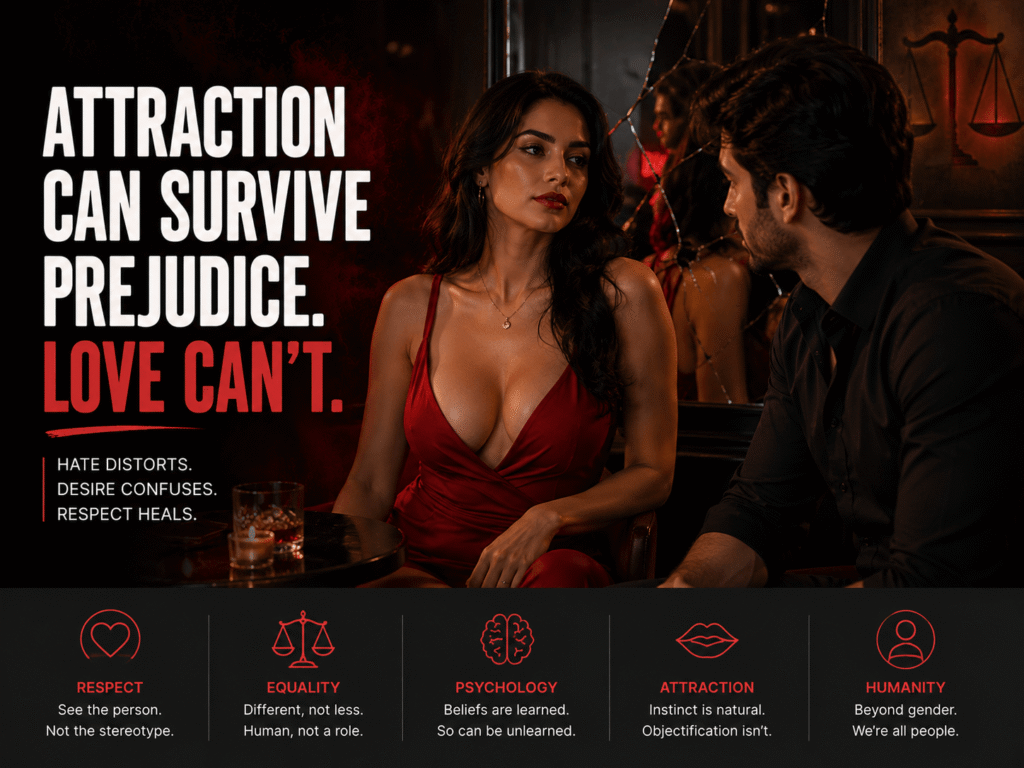
He was twenty-nine, successful, charismatic, and brutally honest.
“I don’t trust women,” he said.
“They’re manipulative. They only care about status. They’re impossible to understand.”
Ten minutes later, without the slightest hesitation, he admitted something else.
“I’ve been on three dates this week.”
The contradiction wasn’t hidden.
It sat comfortably beside him.
For many people, that contradiction is difficult to understand. How can someone claim to dislike women while actively pursuing relationships, flirting, dating, or sex with them? Isn’t attraction supposed to disappear when respect disappears?
Not always.
Human psychology is rarely that simple.
The word misogynist is often thrown around online as an insult, but it has a specific meaning. A misogynist is someone who holds deep prejudice, contempt, or hostility toward women simply because they are women. Misogyny can appear in obvious forms such as discrimination, abuse, or violence. It can also exist in quieter ways, through beliefs that women are naturally inferior, less intelligent, overly emotional, manipulative, or valuable only for what they provide to men.
The opposite of misogyny is not blind admiration for women.
It is gender equality or egalitarianism, the belief that people deserve equal dignity, opportunities, rights, and respect regardless of gender. Someone can disagree with an individual woman, criticize certain behaviours, or leave an unhealthy relationship without becoming misogynistic. Misogyny isn’t about conflict with one person. It’s about prejudice toward an entire gender.
That distinction matters.
Because disappointment is personal.
Hatred is general.
So why does attraction often survive where respect doesn’t?
The answer begins with understanding that sexual desire and personal beliefs are not controlled by the same part of the human experience.
Attraction is influenced by biology, hormones, novelty, fantasy, emotional needs, and physical chemistry. Beliefs are shaped by family, culture, personal experiences, social groups, media, and repeated narratives. The two often influence each other, but they don’t always agree.
That is why someone can crave intimacy while simultaneously carrying resentment.
It’s also why people sometimes remain emotionally attached to partners they openly describe as toxic.
The heart and the mind don’t always vote for the same candidate.
Modern internet culture has amplified this conflict.
Spend enough time online and you’ll quickly discover communities built around resentment. Some portray all women as selfish. Others portray all men as dangerous or emotionally incapable. Algorithms reward outrage because outrage keeps people scrolling. Every painful breakup becomes “proof.” Every bad date becomes another confirmation that an entire gender cannot be trusted.
The human brain loves patterns.
Unfortunately, it also invents them when they’re incomplete.
One betrayal becomes “women always…”
One rejection becomes “men never…”
The individual disappears.
The stereotype survives.
Yet biology continues doing what biology has always done.
People still notice beauty.
Still experience desire.
Still seek affection.
Still want to be wanted.
Hatred rarely erases those instincts.
Sometimes it simply changes how people justify them.
Psychologists often distinguish between sexual objectification and emotional intimacy. Objectification happens when someone views another person primarily as a means to satisfy their own desires, rather than as a complete human being with feelings, boundaries, and autonomy. A person who objectifies women may still seek sex because the attraction is directed toward the body or the fantasy, not the individual. That doesn’t mean everyone who enjoys casual sex is objectifying others. The difference lies in whether the other person’s humanity remains central or becomes secondary.
The opposite dynamic can happen too.
Someone may genuinely admire and respect women while struggling with sexual confidence or desire because of anxiety, trauma, depression, health conditions, or relationship difficulties. Respect does not automatically create libido, just as prejudice does not automatically eliminate it.
This is why psychology warns against reducing human behaviour to a single emotion.
We are capable of holding contradictory beliefs at the same time.
A man may fear vulnerability yet desperately want love.
A woman may distrust relationships yet still dream about commitment.
Someone may speak cynically about marriage while quietly hoping to find a lifelong partner.
Contradictions don’t always mean hypocrisy.
Sometimes they reveal unresolved emotional conflict.
Many attitudes described as misogyny are also rooted in individual experiences that became overgeneralized. A painful divorce, repeated rejection, childhood exposure to unhealthy relationships, or growing up in an environment where contempt for women was normalized can shape beliefs that later become difficult to question. Those experiences explain how certain attitudes develop.
They do not justify treating others unfairly.
Understanding the origin of prejudice is different from excusing it.
Fortunately, beliefs are not permanent.
Research on prejudice consistently shows that meaningful, respectful interactions with individuals from groups we stereotype can weaken those stereotypes over time. Honest conversations, emotionally healthy relationships, and self-reflection often challenge assumptions more effectively than arguments ever do.
That may be the most hopeful part of this conversation.
People are not trapped by the worst ideas they have inherited.
Misogyny is learned.
Respect can be learned too.
The same is true in reverse.
Misandry, the prejudice or hatred directed toward men simply because they are men, follows many of the same psychological patterns. Just as misogyny reduces women to stereotypes, misandry reduces men to assumptions about aggression, privilege, emotional emptiness, or danger. Both replace curiosity with certainty. Both make genuine intimacy harder because intimacy depends on seeing another person as an individual rather than a category.
Perhaps that is the quiet tragedy beneath every gender war.
People who long to be understood slowly stop trying to understand each other.
They keep dating.
They keep having sex.
They keep searching for connection.
Yet every interaction becomes another opportunity to confirm old fears instead of discovering new truths.
Real intimacy asks something much harder.
Not whether someone deserves your attraction.
But whether they deserve to be seen as fully human.
That question changes relationships far more than desire ever could.
FAQ
What is a misogynist?
A misogynist is someone who holds prejudice, contempt, or hostility toward women because they are women. Misogyny can range from discriminatory beliefs to harmful behavior and systemic inequality.
What is the opposite of misogyny?
The opposite of misogyny is gender equality or egalitarianism—the belief that people deserve equal dignity, rights, opportunities, and respect regardless of gender.
Can someone be sexually attracted to people they stereotype?
Yes. Sexual attraction and personal beliefs are influenced by different psychological processes. A person may experience attraction while still holding prejudiced beliefs, although such beliefs can undermine healthy, respectful relationships.
Does having a bad relationship make someone a misogynist?
No. Disliking or criticizing an individual based on their actions is different from holding negative beliefs about all women. Misogyny involves generalized prejudice toward women as a group.
Can misogynistic attitudes change?
Yes. Like many forms of prejudice, misogynistic beliefs can change through self-reflection, education, meaningful relationships, and exposure to perspectives that challenge stereotypes.
Attraction, resentment, desire, and respect don’t always move in the same direction. Understanding why they conflict may be the first step toward healthier relationships and deeper intimacy. Explore more editorials on modern masculinity, sexuality, psychology, identity, and human connection through the lens of emotional intelligence only here at Sex ‘N’ Cigarette.
Recommended Reads: