
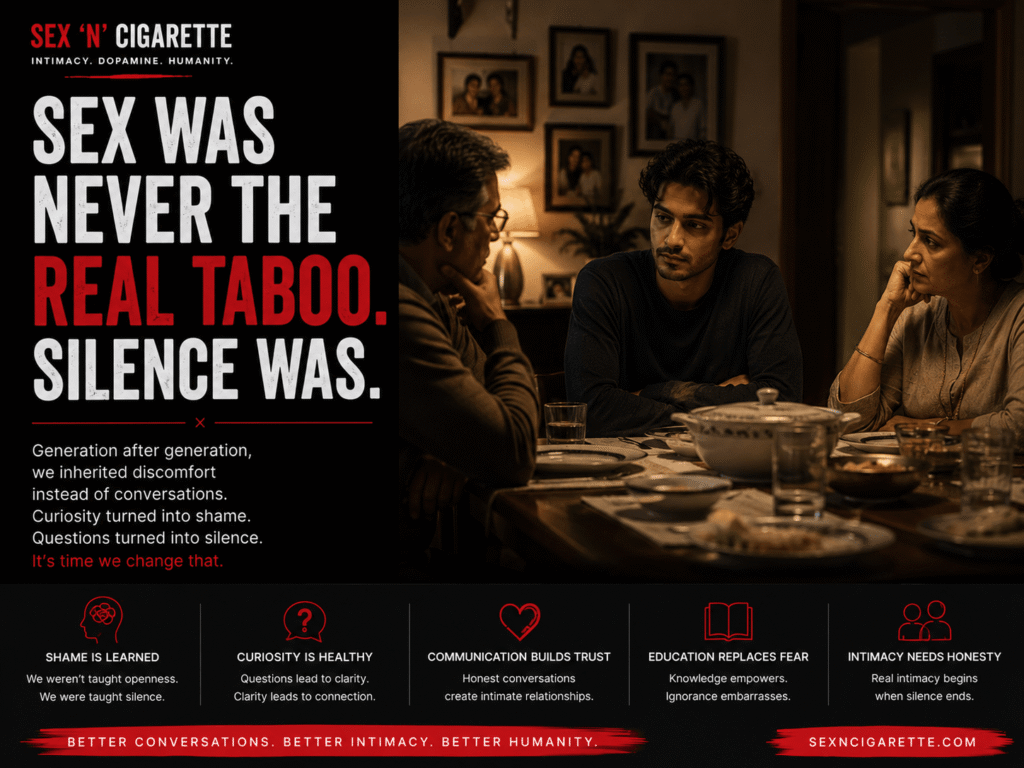
Walk into almost any bookstore and you’ll find shelves dedicated to business, productivity, finance, fitness, and parenting. Turn on the television and you’ll see romance, desire, and attraction used to sell everything from perfumes to luxury cars. Open social media and sexual innuendo appears within minutes. Yet ask a family to sit together and have an honest conversation about sex, consent, pleasure, contraception, or intimacy, and the room often becomes noticeably quieter.
How did one of the most universal human experiences become one of the most uncomfortable conversations in modern society?
The answer isn’t as simple as religion, culture, or morality, although each has played an important role. Historians and anthropologists have long shown that attitudes toward sexuality have changed dramatically across civilizations. Ancient societies didn’t all think about sex in the same way. Some celebrated it through art and literature. Others regulated it more strictly. What remained consistent, however, was that sexuality was never viewed as just another biological function. It carried enormous social consequences because it influenced families, inheritance, power, reputation, and community life. Once sex became connected to social order, it also became connected to rules.
Those rules gradually evolved into silence. Parents often avoided the subject because their own parents never discussed it with them. Schools focused on biology while leaving emotional intimacy unexplored. Popular culture exaggerated sex while real conversations about communication, consent, vulnerability, and pleasure remained surprisingly rare. Generation after generation inherited not only knowledge, but also discomfort. Over time, many people learned that curiosity about sex was acceptable in private but embarrassing in public. The result was a strange contradiction. Society became increasingly comfortable consuming sexual content while becoming increasingly uncomfortable talking honestly about sexual well-being.
Psychologists frequently describe shame as one of the most powerful social emotions because it doesn’t merely influence behavior. It influences identity. When people grow up believing that normal questions about sexuality are inappropriate, they often stop asking those questions altogether. Confusion quietly replaces curiosity. Myths replace education. Silence replaces understanding. By adulthood, many couples find themselves discussing careers, mortgages, and parenting with remarkable confidence while struggling to express even simple desires or boundaries in the bedroom.
The internet changed that equation, but not necessarily in the way many expected. Information became abundant. Wisdom did not. People suddenly had access to unlimited content about sex, yet very little guidance about intimacy. Algorithms rewarded shock value. Adult entertainment became easier to find than thoughtful conversations about emotional connection. As a result, many people learned about performance long before they learned about communication. The cultural taboo didn’t disappear. It simply changed shape. We became comfortable watching strangers talk about sex while remaining uncomfortable discussing it honestly with the people we love.
Research in relationship psychology consistently points toward a different reality. Couples who communicate openly about intimacy, boundaries, preferences, and expectations generally report higher relationship satisfaction than those who avoid these conversations. The reason isn’t complicated. Intimacy grows where trust exists, and trust grows where people feel emotionally safe enough to speak without fear of judgment. Sex itself isn’t what strengthens relationships. Honest communication about sex often does.
Perhaps that’s the lesson modern culture is only beginning to understand. The opposite of taboo isn’t promiscuity. The opposite of taboo is education. It’s maturity. It’s the ability to discuss one of life’s most fundamental experiences with the same respect, empathy, and emotional intelligence that we bring to conversations about health, family, or mental well-being.
Sex has never been the real taboo.
The real taboo has always been vulnerability.
Because talking honestly about intimacy requires something many people find even more frightening than sex itself.
It requires being fully seen.
If this article challenged the way you think about intimacy, explore more conversations about sexuality, psychology, relationships, emotional intelligence, and modern culture at Sex ‘N’ Cigarette.
Because better relationships begin with better conversations.
Recommended Reads: