
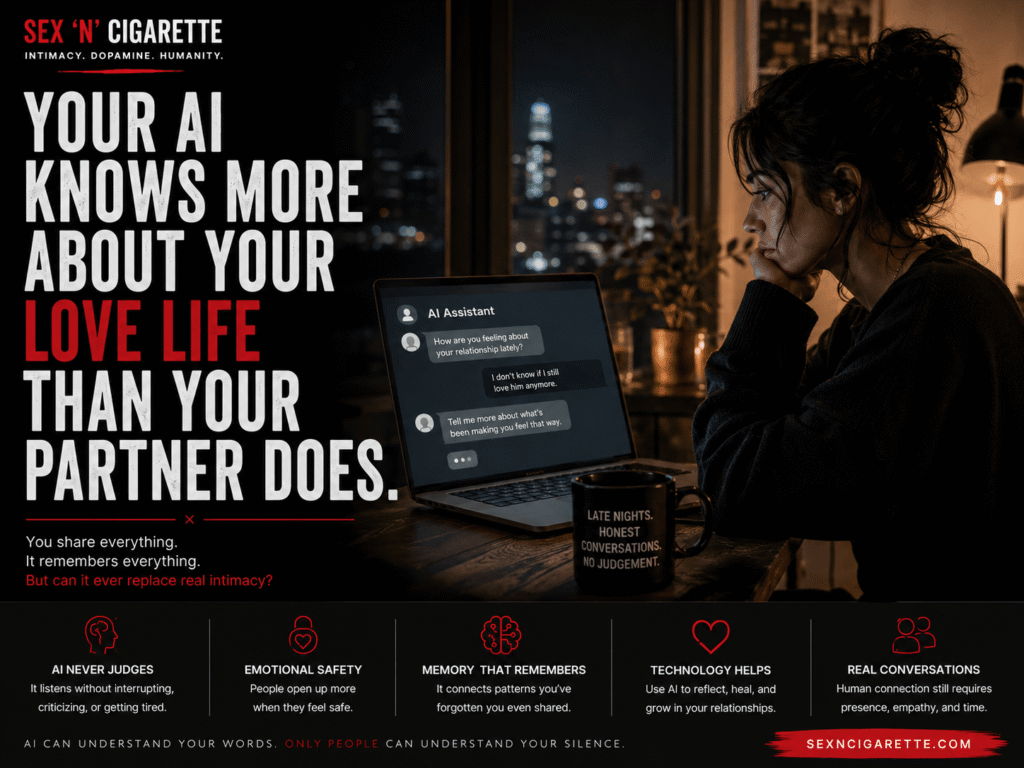
Somewhere in the world tonight, a woman will ask an AI whether she’s falling out of love. A college student will paste an entire WhatsApp conversation and ask, “What should I reply?” A husband will describe an argument he hasn’t even told his closest friend about. Someone else will confess a sexual fantasy they’ve never spoken aloud. And before the night is over, millions of people will have shared thoughts with artificial intelligence that they’ve never trusted another human being to hear.
That’s a remarkable shift in human history. For centuries, our deepest emotional conversations belonged to partners, best friends, therapists, or diaries. Today, they increasingly begin with a blinking cursor and a chatbot that never interrupts, never rolls its eyes, never leaks a secret, and never tells us we’re being irrational. The technology isn’t replacing love. But it is quietly changing where people go when they’re trying to understand it.
Recent surveys and media reporting suggest that people are increasingly using AI to navigate relationships, draft difficult messages, process breakups, and even explore questions about sexuality and identity. The appeal isn’t difficult to understand. AI is available twenty-four hours a day. It remembers previous conversations. It responds instantly. Most importantly, it creates something many people struggle to find elsewhere: the feeling of being heard without immediately feeling judged. That emotional safety can be incredibly attractive, particularly in a world where loneliness and social isolation remain persistent concerns.
Psychologists have long understood that people reveal more when they believe they’re in a low-risk environment. Strip away the fear of embarrassment, rejection, or criticism, and honesty often becomes easier. That’s one reason anonymous online communities became so popular. AI takes that phenomenon a step further. It isn’t simply anonymous. It feels attentive. Ask it about your relationship today, and it remembers what you shared last week. Mention your childhood fears, your attachment style, or your insecurities, and those conversations become part of a growing emotional archive. In a strange way, your AI can begin connecting the dots in your emotional life long before another person ever sees the full picture.
That raises an uncomfortable question. If your AI understands your emotional patterns better than your partner does, is the problem the technology, or the relationship? Many couples spend years discussing schedules, bills, and responsibilities while quietly avoiding the conversations that actually define intimacy. They stop asking each other what they’re afraid of. They stop talking about desire. They stop admitting what hurts. Then, almost by accident, they begin telling those things to a machine because the machine never makes them feel inconvenient. The real disruption isn’t that AI has become emotionally intelligent. It’s that many relationships have stopped being emotionally curious.
There’s another side to this story, though, and it’s just as important. AI understands language remarkably well, but it doesn’t experience human emotion. It has never felt heartbreak, anticipated a first kiss, or sat silently beside someone after devastating news. It recognizes patterns in the way people describe love, but it doesn’t love. It can offer thoughtful questions, summarize research, and help people reflect on their own thinking. What it cannot replace is the warmth of a hand held during uncertainty, the relief of being genuinely forgiven, or the quiet comfort of someone choosing to stay when life becomes difficult. Human intimacy is more than conversation. It’s presence.
Perhaps that’s why the future won’t belong to people who replace relationships with AI. It will belong to people who use AI to become better at relationships. Imagine using it to understand recurring conflicts before discussing them with your partner. Imagine asking it to explain attachment styles, improve communication, or challenge unhealthy assumptions. In that role, AI becomes less like a substitute partner and more like a thoughtful editor helping us write better emotional stories. That’s an extraordinary opportunity, if we remember where the final conversation still belongs.
The greatest irony of this technological revolution may be that AI is teaching us something profoundly human. It reminds us how desperately people want to feel understood. They want someone, or something to listen carefully, remember what matters, respond thoughtfully, and create enough emotional safety for honesty to emerge. Those needs existed long before artificial intelligence. AI simply exposed how many of them were already going unmet.
So perhaps the question isn’t whether AI knows more about your love life than your partner.
The more important question is whether you’ve been telling your AI the conversations your partner has been waiting to hear.
If this article made you rethink the future of intimacy, explore more conversations about AI, attraction, sexuality, dopamine, emotional intelligence, and modern relationships at Sex ‘N’ Cigarette.
Because technology can help us understand ourselves, but only people can truly share a life with us.
Recommended Reads: