
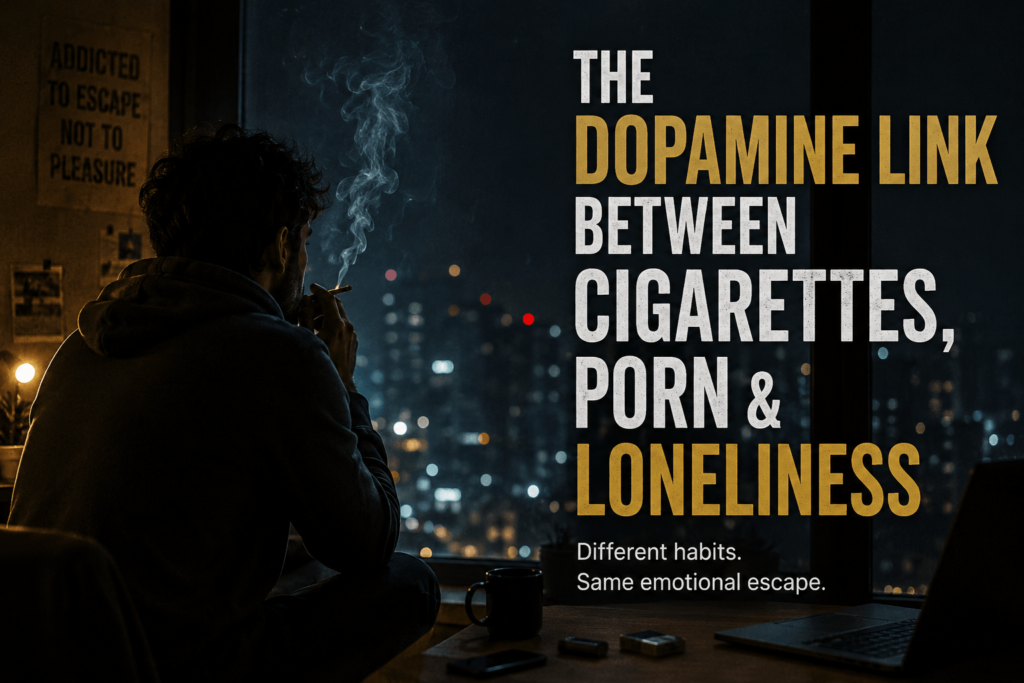
At first, it doesn’t look connected.
A cigarette after stress.
Porn late at night.
Mindless scrolling.
Another dopamine hit before bed.
Most people treat these as separate habits.
But psychologically, they often come from the same emotional place:
the need to temporarily escape emotional discomfort.
Loneliness rarely announces itself dramatically.
Most of the time, it arrives quietly.
In long silences.
In overstimulation.
In emotional numbness.
In the inability to sit alone without needing distraction.
And modern dopamine systems have become exceptionally good at exploiting that discomfort.
Why People Reach for Dopamine During Emotional Pain
Human beings naturally seek relief.
When people feel:
- anxious
- emotionally disconnected
- rejected
- uncertain
- lonely
the brain immediately searches for regulation.
In healthier environments, that regulation might come from:
- conversation
- intimacy
- movement
- emotional connection
- community
But modern digital life offers something faster.
Instant stimulation.
A cigarette delivers temporary calm.
Porn delivers temporary escape.
Social media delivers temporary validation.
The brain learns quickly:
discomfort can be interrupted.
And eventually, people stop processing emotions.
They start managing them chemically, digitally, and behaviorally.
The Emotional Psychology Behind Cigarettes
Most smokers already know nicotine is addictive.
But what many people underestimate is the emotional ritual surrounding smoking.
For many people, cigarettes become:
- emotional pauses
- stress regulation tools
- loneliness companions
- identity anchors
Smoking often appears during moments of:
- heartbreak
- anxiety
- social isolation
- emotional overwhelm
Not because nicotine solves emotional pain.
But because it briefly interrupts it.
That interruption creates relief.
And the brain remembers relief more powerfully than logic.
This is why many smokers don’t just miss nicotine when quitting.
They miss the emotional rhythm attached to it.
The balcony conversations.
The late-night silence.
The temporary feeling of calm after emotional chaos.
Pornography & Emotional Escapism
Pornography operates through a similar dopamine mechanism.
Not everyone who watches porn is addicted.
But many people unconsciously use it as emotional regulation.
Especially during:
- loneliness
- boredom
- rejection
- stress
- emotional emptiness
The brain receives:
- novelty
- stimulation
- anticipation
- temporary pleasure
without requiring emotional vulnerability.
And over time, this creates a dangerous emotional shortcut:
stimulation without connection.
That distinction matters more than most people realize.
Because human intimacy was never meant to function purely as dopamine consumption.
Real intimacy includes:
- uncertainty
- vulnerability
- emotional presence
- patience
- connection
But dopamine-driven environments condition the brain toward speed and novelty instead.
Loneliness in the Age of Hyperstimulation
Modern society is more connected than ever.
Yet loneliness is rising globally.
That contradiction confuses many people.
But hyperstimulation and emotional connection are not the same thing.
A person can:
- receive messages all day
- consume endless content
- interact online constantly
and still feel emotionally starved internally.
Because the nervous system doesn’t measure stimulation as intimacy.
It measures emotional safety.
And modern digital environments overload people with stimulation while quietly depriving them of emotional depth.
This creates a cycle many people now live inside unconsciously:
emotional discomfort → dopamine behavior → temporary relief → emotional crash → repeat.
Over time, people stop asking:
“Why do I feel this way?”
And start asking:
“What can distract me faster?”
Why Modern Dopamine Systems Feel So Powerful
Cigarettes, pornography, social media, dating apps, short-form content…
they all activate similar psychological reward systems.
Not identically.
But similarly enough that the brain begins craving constant interruption.
The problem is not pleasure itself.
Pleasure is human.
The problem begins when stimulation becomes the primary coping mechanism for emotional discomfort.
Because eventually:
stillness feels unbearable.
Silence feels threatening.
And emotional presence becomes harder to tolerate without distraction.
This is why so many people today struggle with:
- focus
- intimacy
- emotional regulation
- attention span
- loneliness
while simultaneously consuming more stimulation than any generation before them.
Relearning Emotional Presence
Healing doesn’t necessarily begin with eliminating pleasure.
It begins with awareness.
With recognizing when stimulation is serving as:
- enjoyment
- connection
- healthy pleasure
versus emotional escape.
Sometimes loneliness doesn’t need more distraction.
Sometimes it needs:
- conversation
- reflection
- human closeness
- emotional honesty
- slowness
Modern life trains people to constantly consume.
But emotional health often improves when people slowly relearn how to simply be present again.
Without immediately reaching for stimulation every time discomfort appears.
Because not every uncomfortable emotion is a problem to eliminate.
Sometimes it’s information.
And sometimes the behaviors people think are helping them survive emotionally…
are actually the very things keeping them disconnected from themselves.
If this article resonated with you, explore more insights on dopamine psychology, emotional wellness, intimacy, addiction, and modern human behaviour at Sex ‘N’ Cigarette.
Because understanding behavior starts with understanding the emotional systems behind it.