
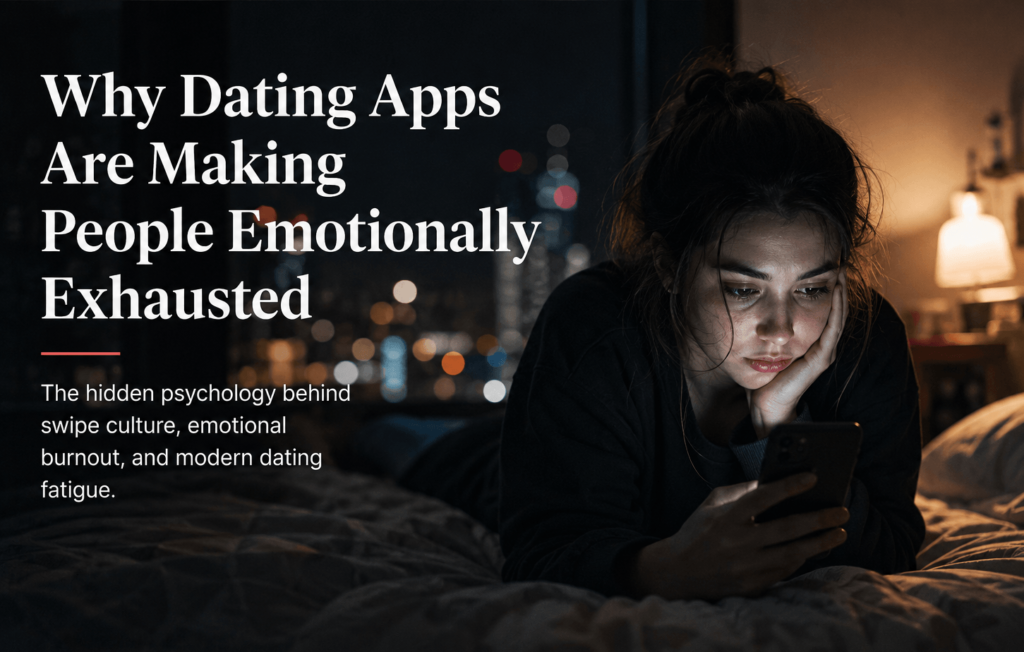
At 1:13 AM, she was still scrolling.
Not because she was excited.
Not because she believed the next swipe would change her life.
But because modern dating has quietly trained people to confuse stimulation with hope.
A face.
A bio.
A dopamine hit.
Another face.
Another possibility.
Another temporary distraction from loneliness.
Somewhere between endless matching, unread messages, ghosting, and emotionally unavailable conversations, dating stopped feeling human for a lot of people.
It became behavioral.
People still crave intimacy.
Still crave connection.
Still want to feel chosen.
But dating apps changed the emotional rhythm of how people experience all three.
And most people haven’t realized how psychologically exhausting that has become.
The Illusion of Infinite Choice
The strange thing is that dating apps initially felt revolutionary.
For the first time in history, people had access to an almost infinite pool of potential partners from the privacy of their bedroom.
Connection became immediate.
Attention became available on demand.
Validation became measurable.
Matches started replacing uncertainty.
And for a while, it felt empowering.
Until people slowly began experiencing something unexpected:
emotional fatigue.
Not heartbreak.
Not rejection.
Exhaustion.
A kind of emotional burnout that’s difficult to explain unless you’ve lived inside the cycle yourself.
Because modern dating apps don’t just ask people to connect.
They ask them to continuously perform.
To appear attractive.
Interesting.
Emotionally stable.
Witty.
Desired.
Unavailable — but not too unavailable.
People are no longer simply meeting each other.
They’re managing perception inside an endless digital marketplace of attention.
And the human nervous system was never designed for this level of emotional exposure.
The Dopamine Loop Nobody Notices
What makes dating apps psychologically dangerous isn’t rejection.
It’s unpredictability.
Sometimes someone replies instantly.
Sometimes they disappear forever.
Sometimes they obsess over you for three days and emotionally vanish on the fourth.
That inconsistency creates the same psychological reward loop used in casinos and social media platforms:
intermittent reinforcement.
The brain becomes addicted to anticipation.
Not love.
Not intimacy.
Anticipation.
That next notification.
That next match.
That next possibility.
And over time, people stop chasing connection itself.
They start chasing emotional stimulation.
This is why so many people now describe dating as “draining” even when they’re technically receiving attention.
Because attention without emotional safety eventually becomes exhausting.
Why Modern Dating Feels Emotionally Empty
The most painful part is that dating apps have quietly normalized emotional detachment.
Ghosting became ordinary.
Disposable conversations became normal.
People began treating emotional access like content consumption.
If something feels slightly uncomfortable, people leave.
If someone isn’t immediately exciting, people swipe again.
If connection develops slowly, attention shifts elsewhere.
The abundance of choice created a paradox:
people now struggle to emotionally invest because another option is always one swipe away.
And eventually, even intimacy itself starts feeling temporary.
For many people, this creates a strange emotional condition where they are constantly interacting with others while simultaneously feeling deeply alone.
Hyper-connected. Emotionally isolated.
That contradiction defines modern dating more than most people realize.
Dating Apps, Dopamine & Emotional Burnout
There’s also another layer nobody talks about enough:
dopamine exhaustion.
Dating apps function almost identically to other modern dopamine systems.
Social media.
Pornography.
Nicotine.
Short-form content.
All of them condition the brain toward novelty, anticipation, and emotional overstimulation.
People don’t just become addicted to people.
They become addicted to interruption.
To validation.
To possibility.
And once the brain adapts to constant stimulation, stillness begins to feel uncomfortable.
That’s why many people now struggle with deep connection.
Real intimacy is slower.
Quieter.
Less performative.
It requires emotional presence instead of endless stimulation.
And modern digital environments are training people in the opposite direction.
What Healthier Modern Intimacy Might Look Like
None of this means dating apps are evil.
For many people, they genuinely create relationships, marriages, and meaningful human connection.
But the psychological cost of endless emotional availability is becoming harder to ignore.
People are exhausted because modern dating often feels less like discovering another human being…
and more like surviving an infinite audition.
Everyone is visible.
Everyone is replaceable.
Everyone is competing with an algorithmically curated illusion of endless possibilities.
And eventually, people stop approaching dating with curiosity.
They approach it defensively.
Maybe healthier modern intimacy starts with smaller changes.
Less performance.
Less emotional multitasking.
Less dependence on digital validation.
Maybe connection becomes healthier when people stop treating attention as intimacy.
Because they are not the same thing.
And maybe the reason so many people feel emotionally numb in modern dating is because human connection was never supposed to exist inside a system designed to maximize engagement instead of emotional depth.
Dating apps didn’t destroy love.
But they did change the psychological environment surrounding it.
And for many people, the emotional consequences are only now beginning to surface.
If this article resonated with you, explore more insights on modern intimacy, dopamine psychology, emotional wellness, and human connection at Sex ‘N’ Cigarette.
Because understanding people starts with understanding the emotional systems shaping them.