
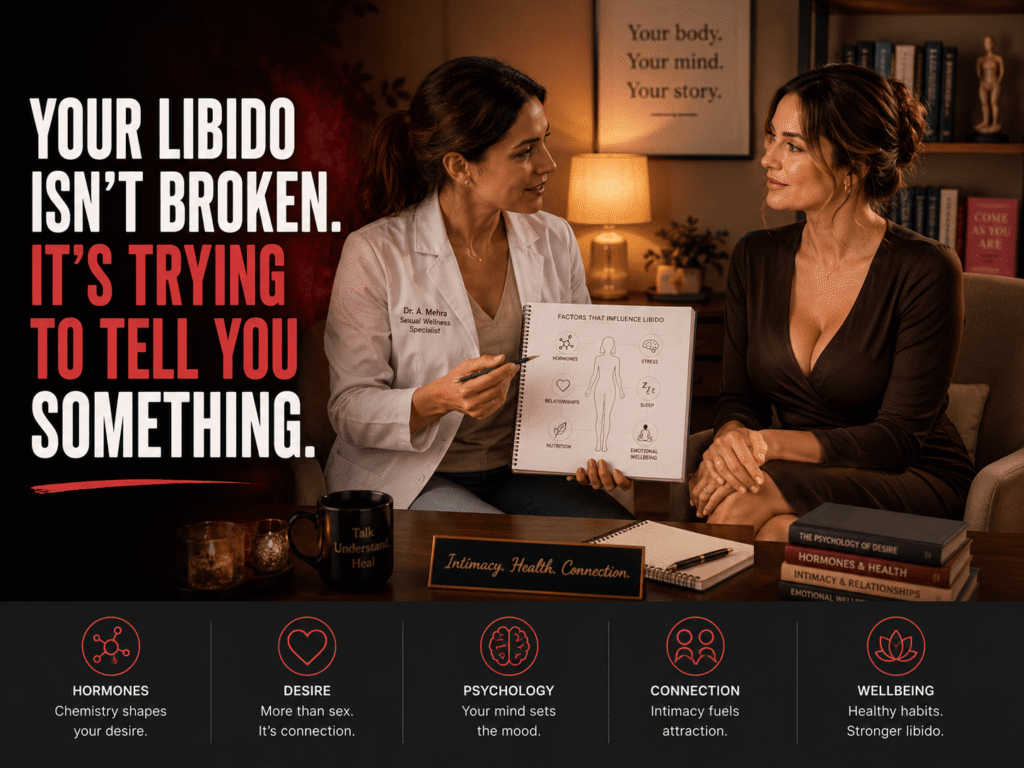
The waiting room was unusually quiet.
A woman in her early forties adjusted the sleeve of her elegant black dress and glanced at the framed certificate hanging behind the doctor’s desk. She looked confident, successful, and composed, yet her fingers kept twisting her wedding ring as though it carried a question she couldn’t say out loud.
When her name was called, she smiled politely before taking a seat.
“I don’t think anything is wrong with me,” she began. “At least that’s what everyone keeps saying.”
The doctor smiled.
“Then what brings you here?”
She hesitated.
“I don’t think I want sex anymore.”
The room stayed silent.
Not awkwardly.
Patiently.
After a few seconds, the doctor leaned forward.
“Do you not want sex?”
“Or do you not feel desire the way you used to?”
She looked surprised.
“I didn’t know those could be different.”
“They usually are.”
That single sentence began a conversation many people spend years avoiding.
The word libido is often misunderstood. People treat it like a switch. Either you have it or you don’t.
Reality is far more interesting.
Libido is your natural sexual desire. It isn’t measured by how often you have sex or how adventurous your bedroom life is. It is the combination of your hormones, physical health, emotional wellbeing, stress levels, relationships, confidence, sleep, medications, and even the way you think about yourself.
In other words, libido isn’t created in the bedroom.
It starts in the brain.
The woman frowned.
“So if my libido is lower than it used to be, does that mean something is broken?”
“Not necessarily.”
The doctor reached for a notepad.
“Imagine your libido as a conversation between your body and your mind. If either one stops listening, desire often becomes quieter.”
She admitted something she hadn’t told anyone.
“I still love my husband.”
“I still think he’s attractive.”
“But by the end of the day I’m exhausted. Work is stressful. My phone never stops ringing. When we finally get into bed, all I want is sleep.”
The doctor nodded.
“That’s one of the most common stories I hear.”
Stress is one of the biggest libido killers.
When your brain believes you’re constantly solving problems, it prioritizes survival over pleasure. Cortisol, the body’s primary stress hormone, quietly competes with the systems responsible for sexual desire. You may still love your partner deeply, but your body has shifted into productivity mode instead of intimacy mode.
Many couples mistakenly interpret this as falling out of love.
Sometimes it’s simply emotional overload.
She laughed nervously.
“My husband thinks men always want sex more than women.”
The doctor smiled again.
“That’s one of the oldest myths in modern relationships.”
Men and women both experience libido, but they often experience it differently.
For many men, libido can feel more spontaneous. Desire appears first, followed by arousal. Testosterone plays an important role, but so do confidence, emotional health, sleep, physical fitness, relationship satisfaction, and stress.
For many women, desire is often more responsive than spontaneous. Emotional connection, feeling appreciated, physical comfort, trust, mental relaxation, hormonal changes throughout the menstrual cycle, pregnancy, menopause, and daily stress can all influence sexual interest.
Neither experience is more normal than the other.
They’re simply different conversations between the brain and the body.
That is why comparing one partner’s libido with another rarely helps.
Understanding it does.
The woman stared out of the clinic window.
“So libido isn’t really about sex?”
The doctor smiled.
“It’s about much more than sex.”
People with a healthy libido often describe feeling curious, playful, emotionally connected, confident, and present.
People with low libido frequently blame themselves.
“I’m getting older.”
“I’m not attractive anymore.”
“My relationship is failing.”
“I’ve changed.”
Sometimes those thoughts become the very thing that keeps desire away.
Because shame rarely creates intimacy.
Acceptance often does.
She leaned forward.
“So how do I increase it naturally?”
The doctor didn’t immediately mention supplements or medication.
Instead, he asked,
“When was the last time you slept eight hours?”
She laughed.
“I honestly don’t remember.”
He continued.
“When was the last time you exercised because it felt good instead of because you felt guilty?”
She stayed quiet.
“When was the last time you kissed your husband without expecting it to become sex?”
Another silence.
Then she smiled.
“I think I know where you’re going.”
The doctor nodded.
Healthy libido grows surprisingly well in healthy environments.
Better sleep supports hormone balance.
Regular exercise improves circulation, confidence, mood, and testosterone levels in men while supporting overall wellbeing in women.
A balanced diet rich in fruits, vegetables, healthy fats, whole grains, and adequate protein provides the nutrients your body uses to support hormonal health.
Reducing excessive alcohol and smoking may also improve sexual wellbeing over time.
Managing stress through mindfulness, hobbies, meaningful conversations, or simply taking time away from constant digital stimulation can allow the nervous system to shift away from survival mode.
Perhaps the most overlooked factor is emotional intimacy.
Feeling heard.
Feeling desired.
Feeling emotionally safe.
These experiences often nourish libido just as much as physical attraction.
Before she left, she asked one final question.
“So… is my libido coming back?”
The doctor smiled.
“I don’t think it ever left.”
“I think it got buried underneath deadlines, notifications, expectations, and exhaustion.”
She stood, picked up her handbag, and walked toward the door.
Then she stopped.
“You know what?”
“What?”
“I came here expecting a prescription.”
The doctor laughed softly.
“And what are you leaving with?”
She smiled in a way she hadn’t when she first entered the room.
“Permission.”
“Permission to stop treating my body like a machine and start listening to it again.”
Sometimes libido doesn’t disappear because we’ve stopped loving our partner.
Sometimes it becomes quiet because we’ve stopped making space for ourselves.
Desire rarely grows where life feels rushed.
It grows where the body feels safe, the mind feels calm, and two people remember that intimacy begins long before either of them reaches the bedroom.
FAQ
What is libido?
Libido is a person’s natural level of sexual desire, influenced by hormones, emotional wellbeing, relationships, physical health, stress, and lifestyle.
Can stress reduce libido?
Yes. Chronic stress increases cortisol levels, which may reduce sexual desire and make emotional connection more difficult.
Is low libido normal?
Yes. Libido naturally changes throughout life due to age, hormones, health, stress, pregnancy, medications, and relationship dynamics.
How can I increase libido naturally?
Healthy sleep, regular exercise, balanced nutrition, emotional intimacy, stress management, and open communication with a partner can all support a healthy libido.
Do men and women experience libido differently?
Yes. While every individual is different, men often experience more spontaneous desire, whereas many women experience desire that is more responsive to emotional connection, comfort, and context.
Your libido is more than a measure of sexual desire. It reflects your emotional wellbeing, physical health, relationships, and the way you experience modern life. Explore more editorials from Sex ‘N’ Cigarette on intimacy, pleasure, relationships, and the psychology that shapes human connection.
Recommended Reads:
- The Best Sex Position Fits Your Body, Not the Trend
- Safe Sex Practices That Build Better Intimacy, Not Less
- Your Dopamine Is Designing Your Life
- Your Cigarette Knows Your Emotions Better Than You
- You Didn’t Just Fall in Love With Someone Older. You Fell in Love With How They Made You Feel.
- Aarav Slept With Ex After Marriage And now In Guilt.