
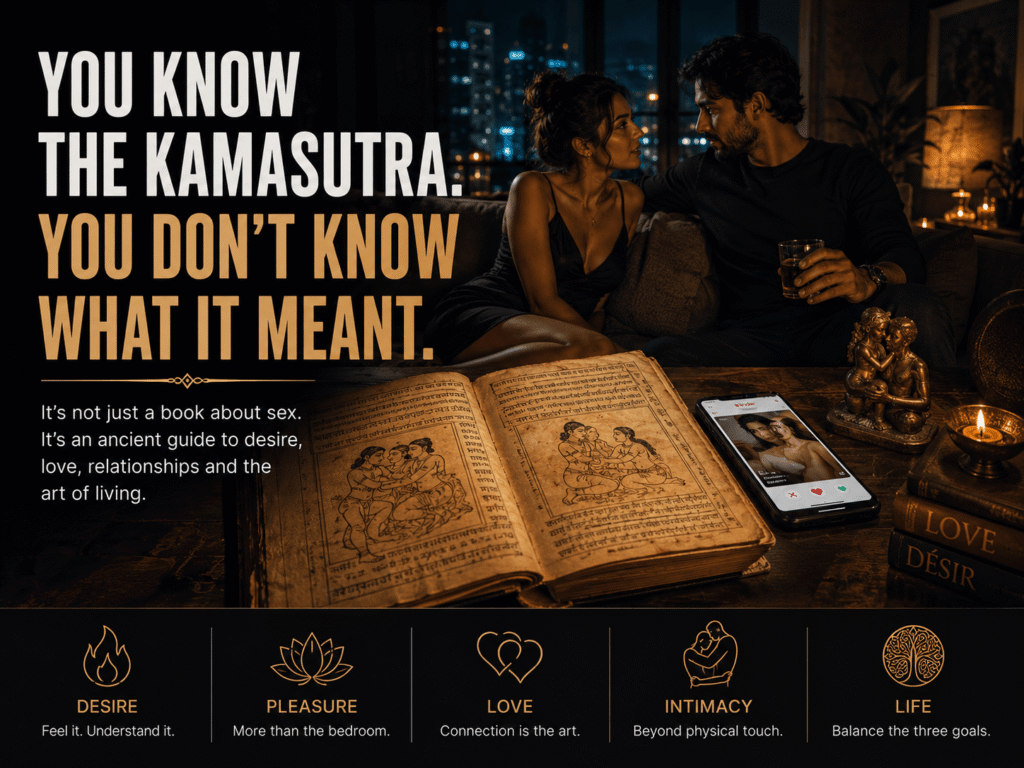
For centuries, one word has been enough to make people curious about an ancient Indian text – Kamasutra.
Say it and most people immediately imagine elaborate sexual positions, erotic sculptures and a mysterious ancient manual that supposedly knew everything about pleasure before modern science arrived.
That image is powerful.
It is also incomplete.
The Kamasutra does contain extensive material about sexual behaviour. That part is real. But reducing the entire work to a catalogue of sexual positions is like describing a modern relationship book as a collection of kissing tips because one chapter discusses kissing.
The more interesting question is not how adventurous the Kamasutra was in bed.
It is why an ancient text about kama, desire and pleasure felt the need to talk about courtship, marriage, social behaviour, personal refinement, attraction, relationships and the pursuit of a satisfying life in the first place.
That is where the Kamasutra becomes much more interesting to the modern reader.
The existing SNC article already points toward this broader interpretation, describing the text as a work concerned with sexuality, relationships, lifestyle, social conduct and personal fulfilment rather than simply sexual positions. Academic scholarship goes further. Cambridge’s Love in South Asia describes Vatsyayana’s Kamasutra as a classical shastric text that instructed its intended reader about knowledge, the household, social and romantic relationships, sexual behaviour, marriage, wives and courtesans.
The ancient text was asking a question that modern dating culture still hasn’t solved:
How do you build a life in which desire has a place without allowing desire to consume everything else?
That question feels surprisingly modern.
The Kamasutra Was Never Only About the Bedroom
The title itself gives us a clue.
Kama is commonly associated with desire, sensual pleasure, love and enjoyment. Sutra refers to a concise teaching or aphoristic text.
So the Kamasutra was not simply “the ancient Indian sex book.”
It was a treatise about kama.
That distinction changes the entire way we read it.
The original SNC article identifies several dimensions of the work, including general principles, courtship, marriage, sexual techniques, social conduct, relationship dynamics and erotic arts.
And there is an even bigger philosophical point behind that structure.
Cambridge scholarship on Vatsyayana’s relationship with Hindu legal and philosophical traditions notes that the Kamasutra opens by acknowledging dharma, artha and kama, the three elements of the trivarga. Vatsyayana’s position was not simply to pursue pleasure at any cost. The three aims were understood as interconnected, and one should not be pursued by damaging the others.
That is a very different philosophy from the modern idea that pleasure means getting whatever you want whenever you want it.
The ancient argument was closer to balance.
Desire matters.
Money matters.
Social responsibility matters.
And a satisfying human life requires negotiating between them.
Suddenly, the Kamasutra stops looking like an ancient collection of bedroom tricks.
It starts looking like a conversation about how human beings organize desire.
Maybe the Most Modern Thing About It Is Its Interest in Desire
Modern culture talks constantly about attraction.
Dating apps turn it into algorithms.
Instagram turns it into visual presentation.
Pornography turns it into performance.
Advertising turns it into consumer psychology.
Dating advice turns it into strategy.
And yet people still struggle with the most basic question:
What exactly do I want?
The Kamasutra is fascinating because it does not treat desire as something that exists only during sex.
It considers attraction, courtship, social interaction and the cultivation of an appealing life as interconnected subjects. Cambridge’s scholarship describes its attention to the nagaraka, the sophisticated urban or courtly person, including knowledge, household life, routines, relationships and sexual behaviour.
That tells us something important about the culture in which the text was produced.
Pleasure was not imagined as a switch that turned on when two people entered a bedroom.
It could be cultivated through conversation, appearance, atmosphere, knowledge, social confidence and familiarity with the arts.
That idea feels remarkably close to something modern relationship psychology keeps rediscovering.
Sexual intimacy does not begin with sex.
It begins with the environment two people create around desire.
And Then There Is the Part Everyone Actually Came For
Yes, the sexual material is there.
The Kamasutra discusses sexual approaches and practices in considerable detail. The existing SNC article correctly identifies this as the section that made the work internationally famous, even though it represents only part of the text.
But even here, the modern obsession with positions misses something.
The interesting question isn’t how many positions the text contains.
It is why an ancient author thought sexual pleasure was worth documenting systematically at all.
That itself is culturally revealing.
Sex was being treated as something that could be studied.
Desire could be discussed.
Pleasure could be observed.
Attraction could be analyzed.
Relationships could be examined.
That doesn’t mean the text represents modern ideas about equality, relationships or sexuality. It emerged from a very different social world, with its own hierarchy, gender expectations and assumptions. We should not turn an ancient text into a modern progressive manifesto.
But neither should we reduce it to pornography in book form.
Both interpretations flatten it.
The more interesting reading sits between them.
The Kamasutra is a historical document showing how one intellectual tradition attempted to understand kama as part of human life.
The Bedroom Was Only One Room in the House of Desire
This may be the biggest lesson modern readers miss.
The original article discusses grooming, manners, social conduct, attraction and the arts alongside sexual material.
That combination tells us something contemporary relationships sometimes forget.
Desire is contextual.
You can have physical attraction without emotional safety.
You can have emotional safety without sexual excitement.
You can have chemistry without compatibility.
You can have excellent sex and still have a terrible relationship.
And you can have a deeply connected relationship in which sex changes dramatically across different stages of life.
The Kamasutra’s broader interest in the life surrounding sexual pleasure gives us a useful way to think about this.
Pleasure does not exist in isolation.
It sits inside a person’s life.
Their relationships.
Their social world.
Their expectations.
Their confidence.
Their surroundings.
Their understanding of themselves.
That is precisely why modern intimacy cannot be reduced to technique.
The best bedroom advice in the world cannot compensate for resentment outside the bedroom.
No sexual position can repair contempt.
No amount of novelty can permanently substitute for curiosity about your partner.
And no ancient manual can tell two modern people exactly what their relationship should look like.
What it can do is make us ask better questions.
The Kamasutra Also Forces Us to Talk About Women
This is where the modern conversation becomes more complicated.
There is a tendency to romanticize the Kamasutra as evidence that ancient India was completely sexually liberated.
That would be too simple.
The social world reflected in the text was structured by its own historical realities, including gender hierarchy and social status. Cambridge scholarship emphasizes that the work addressed a particular classical courtly social world and included prescriptions concerning wives, affairs and courtesans.
So the responsible modern reading is neither:
“Ancient India had perfect sexual equality.”
Nor:
“It was merely an ancient sex manual.”
The truth is more complicated.
And complication is exactly what makes the text worth reading.
The Kamasutra gives us evidence that pleasure, attraction and sexual behaviour were serious subjects of intellectual discussion in ancient South Asia, while also revealing the social structures and assumptions of its own period.
That distinction matters because historical texts should not be forced to become whatever modern readers want them to be.
We can learn from them without pretending they were written for us.
What About the Spiritual Side?
This is another area where modern Kamasutra content often becomes careless.
The original SNC article describes spiritual dimensions and suggests that physical intimacy could be connected with deeper experience.
There is a useful idea here, but it needs nuance.
The Kamasutra should not casually be presented as a tantric manual or as a straightforward path to enlightenment. Those are different traditions and concepts that are frequently blended together in popular culture.
What the scholarship does clearly show is that Vatsyayana situates kama alongside dharma and artha, rather than treating sexual pleasure as the only human objective. Cambridge’s discussion of the text specifically emphasizes this relationship between the three aims of life and Vatsyayana’s preference for a balance that does not allow one to destroy the others.
That is already profound enough.
Pleasure does not have to be shameful.
But pleasure does not have to become the whole purpose of existence either.
There is a middle ground.
And perhaps that is the ancient idea modern culture needs most.
Why Are We Still Obsessed With It?
Because the Kamasutra sits at the intersection of everything humans remain fascinated by.
Sex.
Love.
Beauty.
Power.
Desire.
Marriage.
Attraction.
Pleasure.
Identity.
And the eternal human question of how much pleasure is enough.
It also contains something modern internet culture understands extremely well.
Mystery sells.
For centuries, the Kamasutra existed in a cultural space far removed from the modern internet. Then Western translations, erotic imagery and popular retellings transformed it into something else.
The title became globally recognizable.
The positions became the headline.
The philosophy became the footnote.
And eventually, the Kamasutra became less of a historical text and more of a cultural fantasy.
That transformation tells us almost as much about modern society as it does about ancient India.
We took a complicated text about kama and turned it into a symbol of sexual exoticism.
We wanted the bedroom secrets.
We weren’t nearly as interested in the philosophy of desire.
So What Can the Kamasutra Actually Teach Us Today?
Not how to become a sexual expert overnight.
Not how to make your relationship permanently exciting.
And certainly not a magical formula for perfect intimacy.
Its more interesting lesson is that pleasure belongs inside a larger understanding of life.
Desire needs context.
Intimacy needs attention.
Attraction needs curiosity.
Relationships need negotiation.
And pleasure becomes more meaningful when it exists alongside the rest of our humanity rather than replacing it.
That is remarkably close to what modern intimacy psychology keeps telling us in different language.
We don’t simply want stimulation.
We want to feel wanted.
We don’t simply want sex.
We want connection.
We don’t simply want attraction.
We want to feel seen by the person we’re attracted to.
And sometimes, what makes sex memorable has very little to do with what happened physically.
It was the conversation before it.
The anticipation.
The trust.
The laughter.
The feeling that you could be completely yourself.
The sense that another person was genuinely present with you.
Perhaps that is why the Kamasutra survived.
Not because humans still need a list of ancient sexual positions.
But because humans are still trying to answer the same question Vatsyayana was interested in centuries ago:
How do we make room for desire without losing ourselves in it?
That question has survived because we have.
The technology changed.
The dating rituals changed.
The bedrooms changed.
The language changed.
Desire did not.
And maybe that is the real secret hidden inside the Kamasutra.
It was never only teaching people how to have sex.
It was trying to understand why pleasure matters to human life at all.
FAQ
Is the Kamasutra only about sex?
No. Sexual practices are an important part of the text, but the work also addresses courtship, marriage, social conduct, relationships and the broader pursuit of kama. The original SNC article also emphasizes that it is much broader than a catalogue of sexual positions.
What does Kamasutra actually mean?
Kama broadly relates to desire, sensual pleasure and enjoyment, while sutra refers to a concise teaching or treatise. The text is therefore concerned with the study of kama, not simply sexual positions.
Who wrote the Kamasutra?
The text is attributed to Vatsyayana, traditionally known as Vatsyayana Mallanaga. The historical dating of the work is discussed differently across sources, so it is better to avoid presenting one exact date as certain.
Is the Kamasutra a religious book?
It is a Sanskrit shastra concerned with kama and situated within a broader intellectual framework that also recognizes dharma and artha. It should not simply be described as a religious sex manual. Cambridge scholarship specifically discusses Vatsyayana’s treatment of the trivarga.
Does the Kamasutra teach sexual positions?
Yes. Sexual practices and positions are an important section of the text, which is one reason the work became so famous. But treating that section as the entire Kamasutra misses much of its broader subject matter.
Is the Kamasutra relevant to modern relationships?
It can be read as a historical source for thinking about desire, attraction, relationships and pleasure. However, its social assumptions belong to its historical context and should not automatically be treated as modern relationship advice.
Is the Kamasutra the same as Tantra?
No. Popular culture often blends the two, but the Kamasutra and tantric traditions should not be treated as interchangeable.
The Kamasutra is often presented as an ancient book of sexual positions. Look closer and you find something much more complicated: a historical conversation about desire, pleasure, relationships, social life and the place of kama in a meaningful human existence.
If modern intimacy interests you beyond the bedroom, explore more from Sex ‘N’ Cigarette, where sexuality, psychology, dopamine, relationships and modern culture meet.
Recommended Reads:
- Why Does Sex Feel Better After Drinking? The Psychology
- The Truth About Anal Sex That Nobody Talks About
- The Pain of Watching Your Ex-Husband Love Someone Else
- The Best LGBTQ Support Networks for Identity, Family & Wellbeing
- Why Curiosity Makes Cleavage So Attractive
- Can a Misogynist Still Fall in Love?