
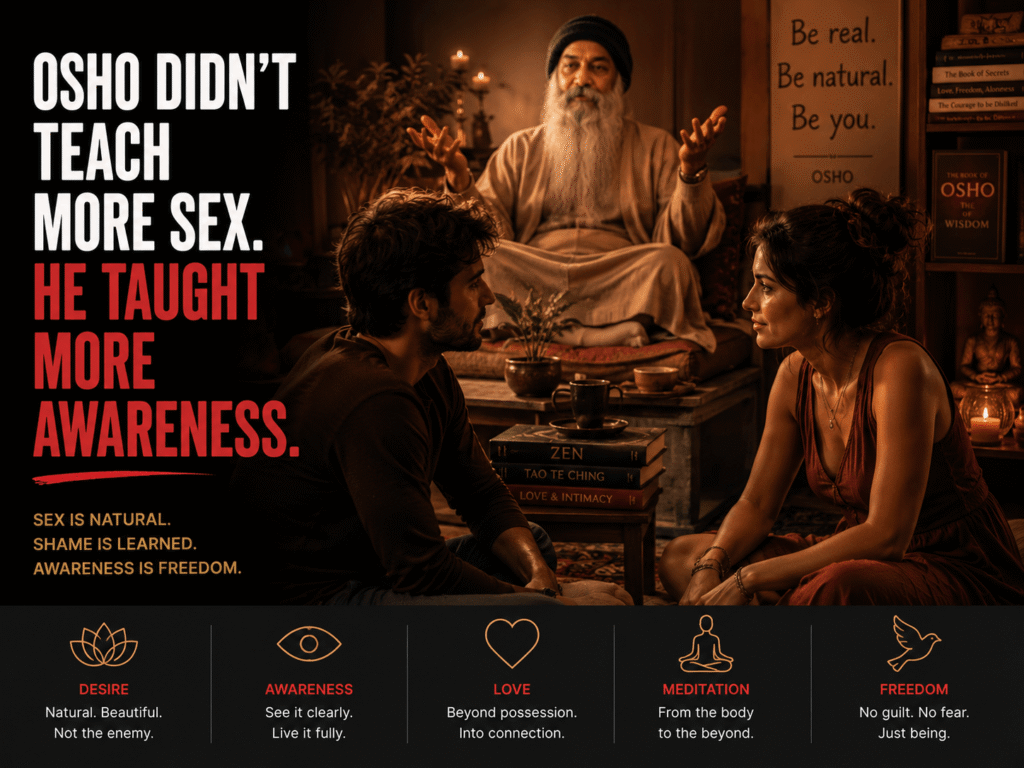
Most people who quote Osho have never actually read him.
His critics often describe him as a man obsessed with sex. His followers sometimes describe him as someone who liberated humanity from sexual shame. Somewhere between those two extremes, the real conversation became buried beneath headlines, controversy, and mythology.
When Osho spoke about sex, he wasn’t trying to convince people to chase more partners.
He was trying to convince them to stop being afraid of one of the most powerful human experiences.
For centuries, many cultures treated sex as something dangerous, sinful, or embarrassing. Desire became something to suppress instead of understand. According to Osho, repression didn’t make people spiritual. It made them divided. When the body wanted one thing and the mind insisted on another, the result was often guilt, secrecy, frustration, and obsession.
That idea still feels surprisingly modern.
Look around today. We live in a world where sex is everywhere and genuine intimacy often feels difficult to find. Dating apps promise endless choice. Social media turns attraction into performance. Pornography is easier to access than meaningful conversations about desire. We appear more sexually open than previous generations, yet many people still struggle to talk honestly about consent, vulnerability, pleasure, or emotional connection.
Perhaps repression has changed its clothes rather than disappeared.
Osho argued that sex should neither be worshipped nor condemned. It should be understood. In his view, desire was a natural part of being human. Fighting it blindly only gave it more power. Awareness, not suppression, was the path forward. When people fully understood their desires instead of hiding from them, those desires no longer controlled every decision they made.
This is one of the most misunderstood parts of his philosophy.
He did not present endless sexual experiences as the ultimate goal of life. Instead, he suggested that awareness could transform every human experience, including sex. He often described the possibility of intimacy becoming deeply meditative, where two people were completely present rather than distracted by performance, fear, or social expectations.
Whether one agrees with him or not, the idea challenges a culture that often treats sex as something to consume quickly rather than experience consciously.
Modern psychology offers an interesting comparison.
Research consistently shows that shame surrounding sexuality can negatively affect relationships, body image, communication, and overall wellbeing. Open conversations about consent, expectations, and emotional safety are associated with healthier relationships. That does not mean every philosophical claim Osho made is supported by modern science, but it does suggest that his criticism of excessive shame around sexuality continues to resonate with many people.
At the same time, Osho’s philosophy also attracts criticism.
Some scholars, psychologists, and former followers have questioned aspects of his movement, his leadership, and the culture that developed around his commune. Others argue that separating his philosophical ideas from the controversies surrounding his organizations is difficult. Those debates remain part of his legacy and deserve acknowledgment alongside his writings.
Perhaps the most valuable question isn’t whether Osho was entirely right or entirely wrong.
Perhaps it is this.
Why are we still uncomfortable talking about sex honestly?
We speak more openly about careers than desire.
More openly about money than loneliness.
More openly about success than intimacy.
Maybe that silence explains why so many people continue searching for answers in podcasts, influencers, therapists, philosophers, and anonymous online forums.
Osho’s greatest challenge to society may not have been his words about sex.
It may have been his insistence that we stop borrowing our beliefs from other people and begin observing ourselves.
Because intimacy isn’t transformed by rebellion alone.
Nor by tradition alone.
It changes when awareness enters the room.
That conversation remains just as relevant today as it was decades ago.
FAQ
Did Osho encourage promiscuity?
Osho criticized sexual repression and encouraged awareness rather than guilt. His teachings are often interpreted differently, and reducing them to advocacy of promiscuity oversimplifies his philosophy.
What was Osho’s view of sex?
He described sex as a natural human experience that could become more conscious and meaningful when approached with awareness instead of shame.
Why are Osho’s teachings controversial?
His philosophy on sexuality, religion, and freedom generated debate, and controversies surrounding his movement and leadership continue to shape public perceptions of his legacy.
Some of history’s most controversial thinkers weren’t trying to give easy answers. They were trying to make us ask better questions. Explore more editorials on intimacy, psychology, relationships, desire, identity, and modern culture. – Sex ‘N’ Cigarette
Recommended Reads:
- How to Increase Libido Naturally and Safely
- The Best Sex Position Fits Your Body, Not the Trend
- Safe Sex Practices That Build Better Intimacy, Not Less
- Your Dopamine Is Designing Your Life
- Your Cigarette Knows Your Emotions Better Than You
- You Didn’t Just Fall in Love With Someone Older. You Fell in Love With How They Made You Feel.