
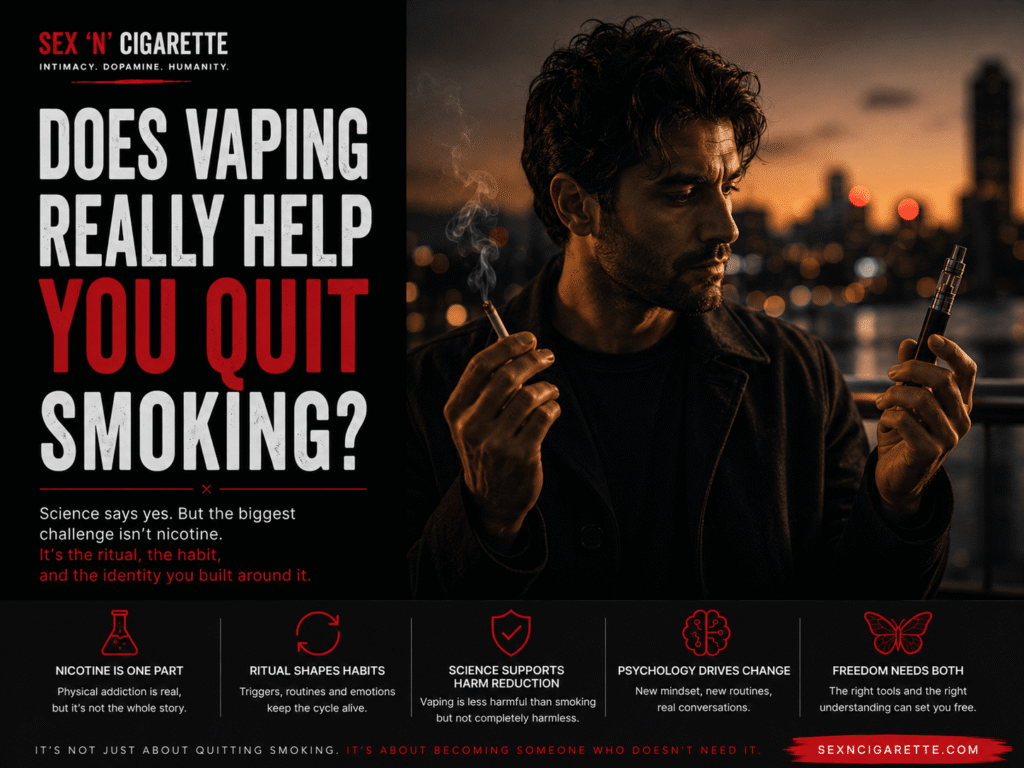
Does Vaping Really Help You Quit Smoking? Science Says Yes. Psychology Says It’s More Complicated.
For years, smokers have been promised the same solution in a different shape.
Swap the cigarette for a vape. Keep the nicotine. Lose the smoke.
On paper, it sounds almost too simple. And for many people, it genuinely works. Clinical research has shown that vaping can help some adult smokers quit combustible cigarettes, especially when combined with behavioural support. Public health bodies in several countries acknowledge that vaping is generally less harmful than continuing to smoke traditional cigarettes, although “less harmful” should never be confused with “harmless.”
The problem is that cigarettes have never been just about nicotine.
If they were, nicotine patches would have ended smoking decades ago.
Researchers studying tobacco dependence have repeatedly found that smoking is built on rituals as much as chemistry. The first cigarette after waking up. The smoke break with colleagues. The quiet moment on the balcony after dinner. The drive home after a stressful day. These routines become deeply connected with emotions, environments, and memories. Eventually, the brain stops asking only for nicotine. It starts asking for the entire experience.
That is where vaping creates an interesting psychological paradox. A vape can satisfy the chemical craving remarkably well. It can also preserve many of the behavioural rituals that cigarettes created. The hand movement remains. The inhale remains. The visible exhale often remains. The quick escape from a stressful meeting remains. For some smokers, that familiarity becomes a bridge away from cigarettes. For others, it simply becomes a new form of nicotine dependence wearing modern technology.
Studies comparing vaping with traditional nicotine replacement therapies suggest that vaping can increase quit success for some adult smokers. At the same time, researchers also report that many people continue vaping long after they have stopped smoking. Instead of ending nicotine use altogether, they transition from one product to another. Whether that should be considered success depends on the goal. If the objective is reducing exposure to the toxic chemicals produced by burning tobacco, vaping may represent meaningful harm reduction. If the objective is complete freedom from nicotine, the journey often continues.
Another factor receives surprisingly little attention. Identity.
People rarely describe themselves by saying, “I consume nicotine.” They say, “I’m a smoker.”
That identity shapes behaviour more than most people realise. Habits become part of personality. Social circles form around smoke breaks. Certain cafés, conversations, and even relationships become associated with cigarettes. Replacing tobacco with a vape doesn’t automatically rewrite that identity. Many former smokers discover that the hardest part wasn’t giving up cigarettes. It was learning who they were without them.
Modern neuroscience offers another clue. Habits become stronger when rewards are unpredictable. A stressful conversation doesn’t always lead to a cigarette, but sometimes it does. That unpredictability strengthens behavioural loops. Simply changing the device doesn’t automatically weaken those neural pathways. They require new routines, new environments, and new emotional responses to gradually lose their grip.
This doesn’t mean vaping has no place in smoking cessation. For many adult smokers who have repeatedly failed with other methods, it can become an important step toward leaving combustible tobacco behind. The evidence supporting harm reduction deserves to be taken seriously. Equally important is recognising that lasting change usually involves more than replacing one product with another. It involves understanding why the cigarette became meaningful in the first place.
Perhaps that’s why the debate around vaping often misses the real point.
The biggest addiction isn’t always the cigarette.
Sometimes it’s the ritual.
And once you understand the ritual, quitting stops becoming a battle against nicotine alone.
It becomes a chance to rebuild the moments that once belonged to smoking.
With something healthier waiting on the other side.
If this article made you see smoking differently, explore more conversations about cigarettes, dopamine, habits, psychology, intimacy, and modern culture at Sex ‘N’ Cigarette.
Because understanding a habit is often the first step toward changing it.
Recommended Reads: