
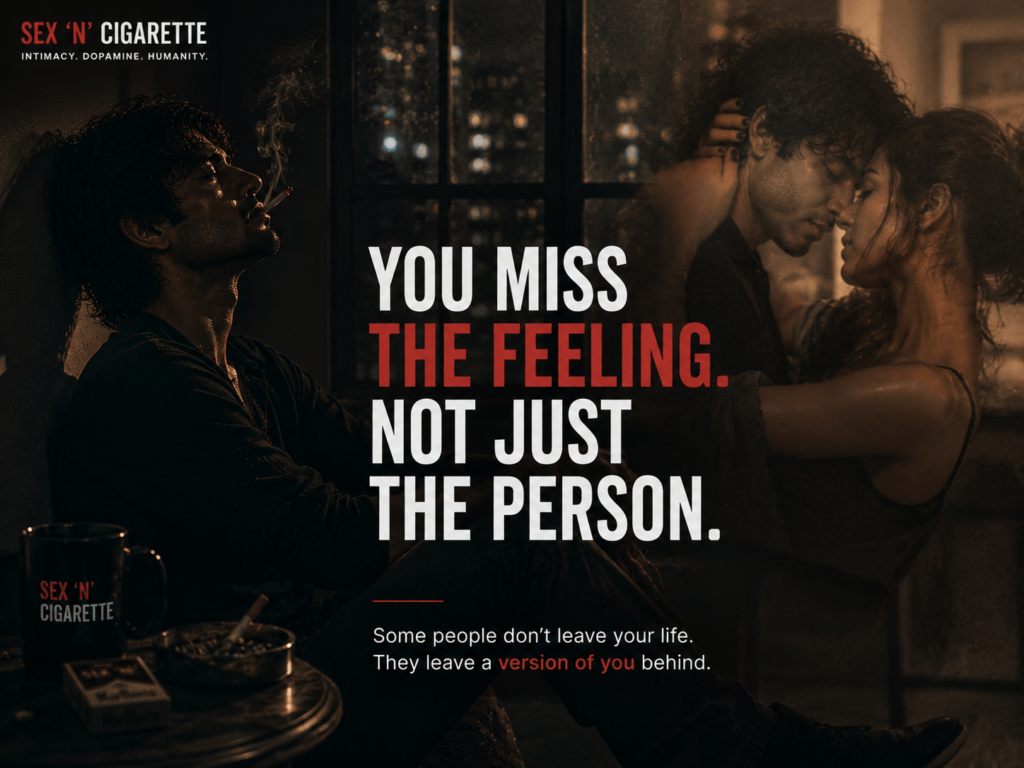
Most heartbreaks are not only about losing another person. Sometimes it’s about losing the version of yourself that briefly felt emotionally alive beside them.
That’s why certain people continue haunting the mind long after conversations stop, intimacy disappears, and the relationship itself objectively ends. The body moves forward faster than the nervous system does. People tell themselves they miss the person, but often what they truly miss is the emotional atmosphere that existed around that connection, the version of themselves that laughed more naturally, desired more openly, slept more peacefully, smoked less anxiously, or felt emotionally understood without constantly needing to explain themselves.
Some relationships temporarily make people feel more emotionally real. And modern dating quietly makes losing that feeling psychologically brutal.
Because today, people rarely lose only one person anymore. They lose routines. Notifications. Voice notes. Late-night attention. Sexual familiarity. Emotional validation. The small dopamine rituals attached to intimacy. Entire emotional ecosystems suddenly disappear overnight. The brain struggles separating love from emotional dependency because modern relationships deeply intertwine attachment with constant digital presence now.
That silence afterward becomes addictive in its own disturbing way.
People revisit old chats.
Old playlists.
Old photographs.
Cigarettes smoked outside apartments after emotionally charged conversations.
The older versions of themselves..
And perhaps that’s why heartbreak today often feels strangely existential instead of purely romantic. Many people are not only grieving another human being. They’re grieving emotional certainty. Grieving emotional safety. Grieving the temporary illusion that someone finally understood the parts of them the world usually never slows down enough to notice.
Cinema always understood this beautifully before social media turned heartbreak into content. Some of the most emotionally devastating romantic films were never about dramatic endings alone. They were about identity transformation through intimacy. People emotionally changed around certain lovers. Became softer. Braver. More expressive. More emotionally visible. And once that emotional mirror disappeared, people no longer recognized themselves the same way afterward.
That emotional withdrawal leaves psychological residue.
Especially in emotionally avoidant modern culture where many people secretly crave intimacy while simultaneously fearing dependence on it. Dating apps, hookup culture, and modern hyper-independence constantly encourage emotional detachment as self-protection. People now try appearing emotionally unaffected even while privately unraveling underneath silence, cigarettes, playlists, gym sessions, late-night drives, and emotionally unfinished thoughts they never fully say aloud.
And perhaps men experience this loneliness differently than society discusses honestly enough.
Many men are not emotionally expressive publicly, but emotionally attach deeply through presence, routine, touch, emotional calmness, and subtle intimacy. They often struggle articulating emotional grief directly, so heartbreak emerges sideways instead, through overworking, emotional withdrawal, smoking more, obsessive self-improvement, casual hookups that feel emotionally empty afterward, or quietly replaying memories nobody around them even realizes still matter psychologically.
But maybe heartbreak also reveals something hopeful underneath all this pain.
Because the emotional version of yourself you discovered around another person was never completely created by them alone.
They revealed it.
Activated it.
Made it easier to access.
But it still belongs to you.
And perhaps healing begins the moment people stop treating love only as emotional dependency and start understanding it as emotional expansion instead. Some relationships do not fail because they were meaningless. Some relationships matter deeply precisely because they temporarily reconnect people back to emotional depth they had forgotten existed inside themselves altogether.
So maybe you don’t actually miss only her.
Maybe you miss feeling emotionally alive in a world that constantly trains people to emotionally numb themselves just to survive modern life more easily.
And maybe the real healing begins when you slowly learn how to become that emotionally open version of yourself again, even without needing another person to temporarily unlock it for you first.
If this article resonated with you, explore more conversations around attraction psychology, heartbreak, masculinity, emotional intimacy, dopamine culture, and modern relationships at Sex ‘N’ Cigarette.
Because sometimes heartbreak is really the loss of emotional aliveness itself.
Also Read: