
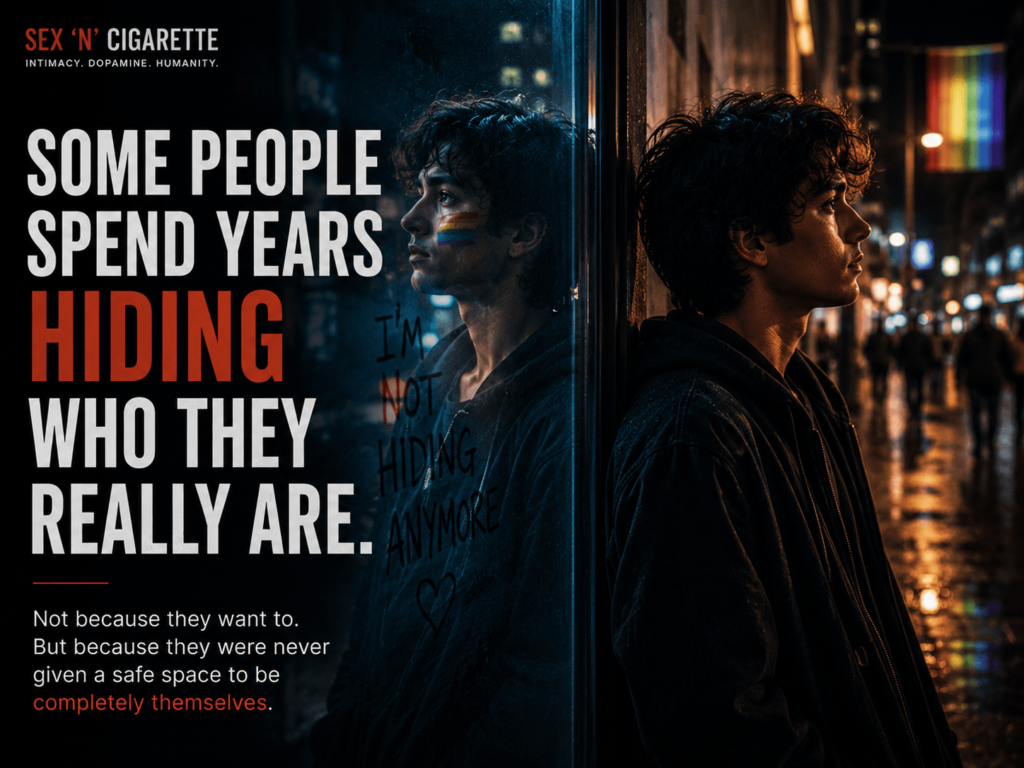
Some people do not grow up learning how to express themselves. They grow up learning how to edit themselves.
The voice becomes softer around certain people. The body language changes depending on the room. Interests get hidden. Attraction gets disguised. Opinions become filtered. Entire parts of identity slowly get pushed underground, not always because someone explicitly demanded it — but because people quietly learn which versions of themselves feel emotionally safer for the world around them.
And over time, performance starts replacing authenticity so gradually that many people no longer recognize where the performance even began.
This happens across far more lives than society openly acknowledges. LGBTQ+ people often experience it deeply, but emotional masking exists far beyond sexuality alone. Many men hide emotional softness. Many women hide anger or ambition. Many queer people hide attraction. Many people from conservative families hide identity entirely while living double emotional lives between private truth and public survival.
And perhaps the most exhausting part is not even the hiding itself. It’s the constant psychological calculation.
The scanning.
The self-monitoring.
The emotional editing before speaking.
The fear of becoming emotionally unsafe in the wrong environment.
Modern internet culture complicated this even more. On one side, visibility increased dramatically. People now see more conversations around identity, sexuality, emotional expression, and acceptance than previous generations ever did. But visibility also created new forms of performance. Many people now feel pressured to “announce,” explain, categorize, brand, or publicly define themselves before they’ve even emotionally understood themselves privately yet.
Identity became content in many spaces. And human beings are rarely that simple emotionally.
That’s partly why so many people quietly feel emotionally fragmented today. They’re constantly switching between versions of themselves depending on context. One personality online. Another around family. Another around friends. Another around romantic partners. Another version entirely inside their own head late at night when nobody else is watching.
And carrying multiple emotional selves becomes psychologically exhausting after enough years.
Cinema occasionally captured this beautifully long before social media did. Films about identity were rarely powerful because of labels alone. They became powerful because audiences emotionally recognized the loneliness of hiding. The tension of wanting acceptance while fearing rejection. The quiet relief of finally being emotionally seen by someone without needing to shrink yourself first.
That human feeling is universal.
Because underneath sexuality, masculinity, femininity, labels, culture, and identity politics, most people are ultimately searching for something emotionally simple:
the freedom to exist honestly without constantly calculating whether honesty will cost them connection.
And perhaps that’s why acceptance matters more deeply than modern internet arguments sometimes understand. Real acceptance is not performative tolerance. It’s emotional safety. The feeling that another person can fully know something true about you without emotionally withdrawing from you afterward.
That kind of acceptance changes people psychologically – not overnight, but slowly.
People begin breathing differently around emotional safety. Speaking differently. Laughing more naturally. Existing more fully inside their own body instead of constantly monitoring themselves from the outside. Emotional energy once spent hiding finally becomes available for living.
And maybe healing begins there.
Not in becoming perfectly understood by everyone.
Not in winning every cultural argument online.
Not in forcing identity into simplified categories.
Maybe healing begins the moment people realize they deserve relationships, friendships, spaces, and communities where authenticity no longer feels emotionally dangerous.
Because human beings were never meant to spend entire lifetimes hiding themselves from the world just to feel acceptable inside it.
If this article resonated with you, explore more conversations around identity, emotional intelligence, intimacy, human connection, and modern culture at Sex ‘N’ Cigarette.
Because authenticity should never feel emotionally unsafe.