
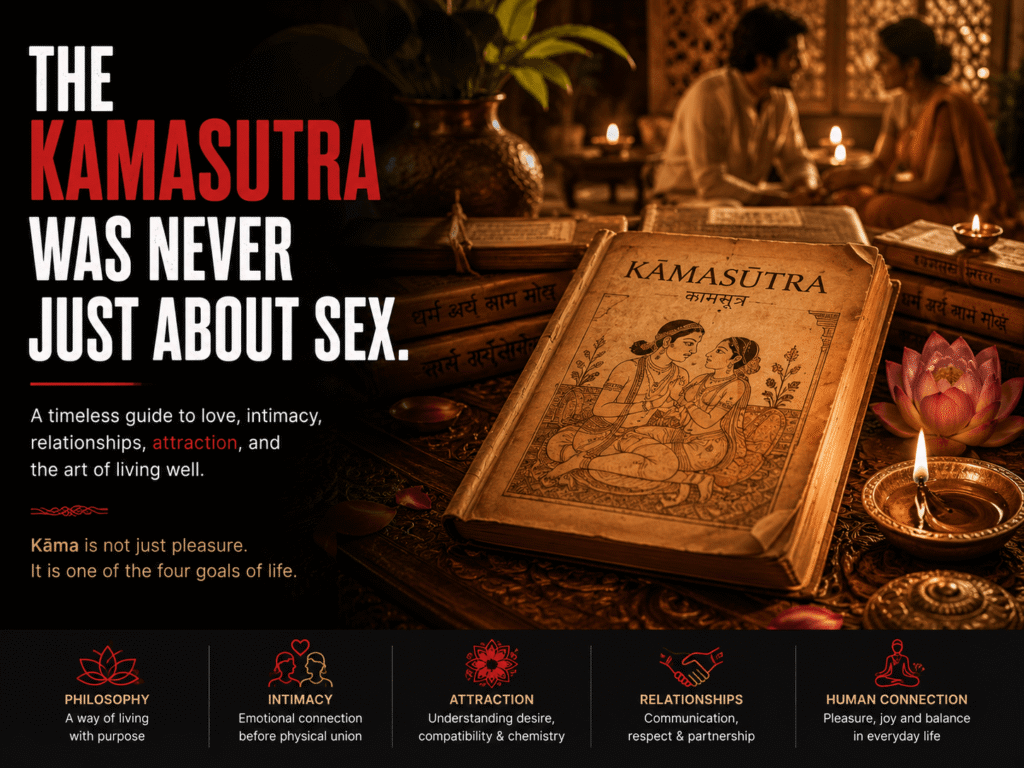
For centuries, the Kamasutra has been one of the world’s most misunderstood books. Mention its name almost anywhere today and the conversation quickly turns toward exotic sexual positions, adult humor, or sensational headlines. Popular culture has reduced an ancient philosophical work into little more than a bedroom manual, leaving most people unaware of what the text was actually written to achieve.
The truth is surprisingly different.
The Kamasutra is not simply a book about sex. It is a guide to understanding human relationships, attraction, emotional intimacy, personal refinement, social behavior, and the pursuit of a fulfilling life. Physical intimacy certainly has a place within its pages, but it represents only one part of a much larger philosophy about how people connect with one another.
Understanding the Kamasutra in its original context changes the way we think about love, desire, and even ourselves. Instead of teaching people how to perform in the bedroom, it teaches them how to build relationships that are respectful, emotionally satisfying, and deeply human.
What Does Kamasutra Actually Mean?
The word Kamasutra comes from two Sanskrit words.
Kāma refers to pleasure, desire, affection, beauty, enjoyment, and emotional fulfillment. It is much broader than physical intimacy and includes everything that brings healthy joy to human life.
Sutra means a thread or a collection of teachings. Ancient Indian scholars used the word to describe concise texts that connected ideas into a complete philosophy.
Together, Kamasutra can be understood as “the teachings on pleasure and human fulfillment.”
That definition alone reveals how much modern society has misunderstood the book. Pleasure, according to the Kamasutra, is not limited to sex. It includes appreciation for beauty, meaningful companionship, conversation, music, art, romance, emotional closeness, and shared experiences.
Who Wrote the Kamasutra?
The Kamasutra is traditionally attributed to Vātsyāyana, an Indian philosopher believed to have lived between the third and fifth centuries CE.
Contrary to popular belief, Vātsyāyana did not claim to invent these ideas. He gathered knowledge from earlier traditions and organized them into a structured work that examined relationships, social customs, marriage, attraction, and pleasure.
His goal was not to encourage indulgence. Instead, he argued that human beings should pursue pleasure responsibly while maintaining balance with ethics, prosperity, and personal growth.
This balanced approach explains why the Kamasutra has remained relevant for nearly two thousand years.
The Four Goals of Human Life
One of the most important ideas behind the Kamasutra comes from ancient Indian philosophy, which describes four primary goals of human life.
Dharma represents ethical living, responsibility, and moral conduct.
Artha focuses on prosperity, security, and material well-being.
Kāma celebrates pleasure, love, beauty, affection, and emotional satisfaction.
Moksha represents spiritual liberation and inner peace.
The Kamasutra focuses on Kāma, but it repeatedly reminds readers that pleasure should never overpower the other three goals.
In other words, a meaningful life is not built by chasing pleasure alone. It is created by balancing happiness with responsibility, purpose, and personal integrity.
That message feels remarkably modern in a world where social media often encourages instant gratification over long-term fulfillment.
How Much of the Kamasutra Is Actually About Sex?
This is perhaps the biggest surprise for first-time readers.
Only a portion of the Kamasutra discusses physical intimacy and sexual techniques. Much of the book explores subjects that many modern relationship experts continue to discuss today.
It talks about meeting potential partners, developing attraction, understanding compatibility, building trust, maintaining marriages, expressing affection, handling conflict, personal grooming, fashion, conversation, etiquette, music, art, and creating an enjoyable social life.
Many readers expect explicit instructions from the very first page.
Instead, they discover a thoughtful examination of how relationships begin, grow, and survive.
The famous illustrations associated with the Kamasutra represent only a small section of a much larger work.
Why Does the Kamasutra Discuss Sex at All?
The Kamasutra never treats sex as something shameful.
It also never treats it as life’s greatest achievement.
Instead, it presents physical intimacy as a natural expression of emotional closeness between two people.
According to the text, satisfying intimacy depends on qualities that exist long before a couple reaches the bedroom.
Respect.
Communication.
Mutual attraction.
Trust.
Patience.
Emotional understanding.
Without these foundations, physical intimacy alone cannot create a healthy relationship.
That idea continues to appear in modern psychological research, where emotional safety and open communication are consistently linked to greater relationship satisfaction.
The Art of Attraction Beyond Physical Appearance
One of the most fascinating aspects of the Kamasutra is its understanding of attraction.
It recognizes that attraction is influenced by appearance, but it also places enormous value on personality, confidence, kindness, conversation, intelligence, and cultural refinement.
The text encourages people to become interesting companions rather than simply attractive individuals.
It speaks about learning music, appreciating literature, understanding humor, developing social confidence, and carrying oneself with dignity.
In many ways, the Kamasutra suggests that emotional attraction grows from curiosity and character as much as physical beauty.
That philosophy feels refreshing in an era dominated by dating apps and carefully edited social media profiles.
What Modern Relationships Can Learn From the Kamasutra
Although written centuries ago, many of the Kamasutra’s ideas remain surprisingly relevant.
It encourages couples to continue discovering each other instead of assuming they already know everything.
It emphasizes spending meaningful time together rather than simply sharing the same space.
It reminds partners to care about their appearance, not because society demands perfection, but because making an effort communicates respect for oneself and for the relationship.
It values conversation as much as physical intimacy.
It recognizes that emotional closeness requires continuous attention rather than occasional grand romantic gestures.
Perhaps most importantly, it suggests that relationships thrive when both partners continue growing as individuals.
These lessons sound remarkably similar to advice offered by modern relationship therapists today.
Why Has the Kamasutra Been Misunderstood?
The answer lies largely in history and popular culture.
When the Kamasutra was translated into English during the nineteenth century, many readers focused almost entirely on the sections discussing sexuality because they appeared unusual and controversial.
Over time, publishers, filmmakers, advertisers, and internet creators discovered that the sexual reputation of the Kamasutra attracted far more attention than its philosophical ideas.
The result was a simplified image that ignored most of the book’s content.
Today, many people know the title without ever understanding its purpose.
Ironically, one of history’s richest books on relationships became famous for only a fraction of what it actually teaches.
The Real Legacy
The greatest contribution of the Kamasutra is not its discussion of physical intimacy.
Its lasting legacy is the belief that pleasure deserves a place within a balanced, meaningful life.
It argues that love should include respect.
Desire should include understanding.
Marriage should include companionship.
Physical intimacy should include emotional connection.
Pleasure should exist alongside responsibility rather than replacing it.
Those principles remain just as valuable today as they were centuries ago.
In a culture that often separates emotional intimacy from physical attraction, the Kamasutra reminds us that the strongest relationships are built when both exist together.
Perhaps that explains why this ancient text continues to inspire readers across generations.
Not because it teaches people unusual ways to have sex.
Because it encourages people to become better partners, better companions, and ultimately better human beings.
The greatest lesson of the Kamasutra is not about what happens behind closed doors.
It is about understanding that love, intimacy, desire, respect, communication, and shared joy are all connected. When those pieces come together, relationships become more than physical experiences. They become meaningful partnerships capable of lasting far beyond passion alone.
If you’re interested in the psychology of intimacy, relationships, attraction, and the cultural stories that shape how we love, explore more editorials from Sex ‘N’ Cigarette.
Recommended Reads:
- Couple Games That Build Trust, Intimacy, and Better Communication
- 5 LGBTQ Leaders Who Changed How the World Sees Love
- The Truth About Open Relationships That Nobody Talks About
- You’re Not Afraid To Ask For New Sex Position. You’re Afraid They’ll See You Differently.
- Your Ultimate Satisfaction: Sex Toys for Solo Exploration
- 5 Paintings That Redefined Love, Sex And Intimacy