
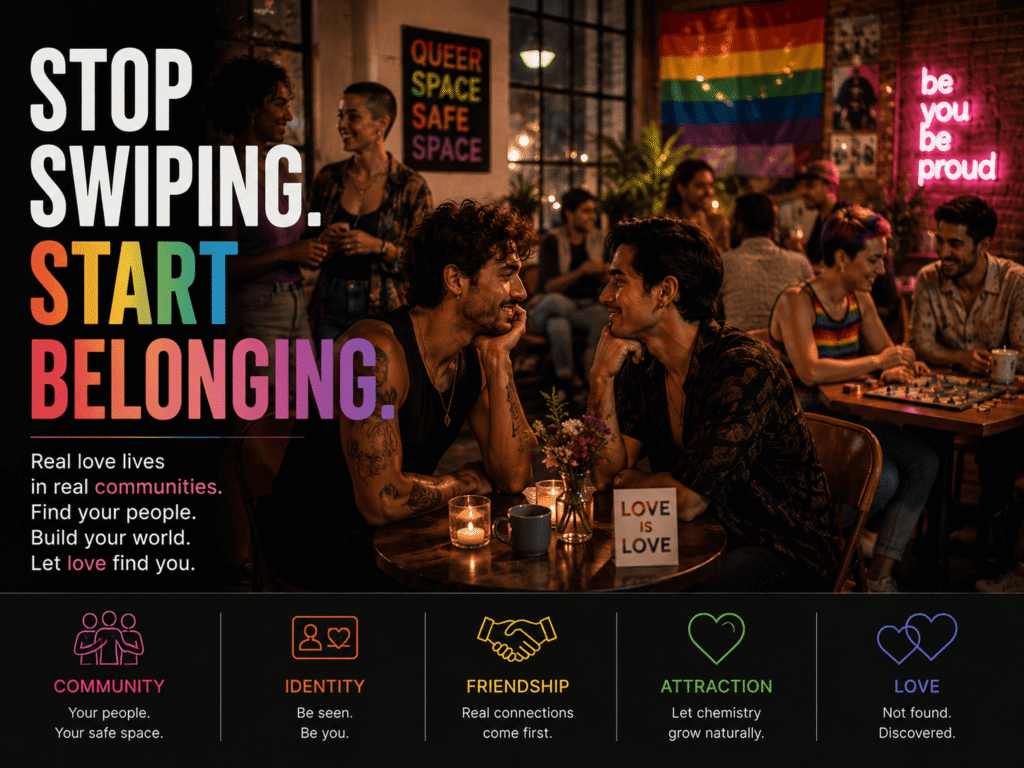
If you are gay and looking for a man, lesbian and looking for a woman, trans and hoping to meet someone who understands the experience without needing a 40-minute explanation, the usual dating advice can feel almost insulting.
Download another app.
Swipe left.
Swipe right.
Write a clever bio.
Wait.
Repeat.
But what if the problem is not that you haven’t met enough people?
What if you have been looking in the wrong places?
For LGBTQ+ people, finding a partner can sometimes be less about searching for a date and more about finding a place where your kind of people naturally gather. A gay man who joins a queer football club may meet another gay man while arguing about a missed penalty. A lesbian who joins a women’s book group might discover that the woman across the table is interested in more than the novel. A trans person who becomes part of a trans-led community may meet someone through a workshop, volunteering, a support group, an arts event or simply through friends of friends.
Nobody joined the room specifically to find a partner.
And that may be precisely why something real can happen there.
The idea behind this article is simple: don’t search only for people who are available. Search for places where people who understand you already exist.
And importantly, this isn’t a guide for straight dating. It is specifically about LGBTQ+ people who want to meet other LGBTQ+ people without relying on dating apps.
1. Start With LGBTQ+ Community Centres
This is probably the most underrated answer.
Community centres are not matchmaking agencies. That is precisely why they can be useful.
They often host workshops, support groups, cultural events, discussion sessions, social gatherings, health programmes, youth activities, film screenings and other community events. The people you meet there have already made one important decision: they want to participate in LGBTQ+ community life.
That gives you something dating apps cannot easily manufacture.
Repeated exposure.
You see the same people.
You talk again.
You become familiar.
You discover who they are outside a profile photograph.
And attraction sometimes develops much more naturally when you aren’t trying to manufacture it.
For people in the United States and Canada, CenterLink maintains a directory of LGBTQ+ community centres and organisations. Its current member directory includes centres and organisations across numerous cities, including organisations serving queer, trans and Two-Spirit communities.
CenterLink LGBTQ+ Community Center Directory
In the UK, Stonewall’s support directory points people toward established LGBTQ+ groups and organisations, including LGBT Foundation and other community organisations.
Stonewall UK LGBTQ+ support resources
The trick is not to walk into a centre thinking, “Where are all the single people?”
Walk in thinking:
“Where are my people?”
The first question searches for a partner.
The second builds a life in which meeting one becomes more likely.
2. Find a Community Around Your Identity, Not Just Your Sexuality
This becomes particularly important when your identity is more specific.
A gay man may want gay male spaces.
A lesbian may want lesbian or queer women’s spaces.
A bisexual person may want a community where bisexuality isn’t treated as indecision.
A trans person may want a trans-led environment.
A non-binary person may want a space where they don’t have to constantly explain their identity.
The broader LGBTQ+ world is enormous, but it isn’t one homogeneous community.
ILGA World is particularly useful here because it maintains a global directory of member organisations. It currently represents more than 2,300 member organisations across more than 170 countries and territories, with organisations covering lesbian, gay, bisexual, trans and intersex communities.
ILGA World Member Organisations Directory
This is not a dating directory.
Use it differently.
Find the organisations operating in your city or country. Look at what they actually do. Find their public events, cultural programmes, workshops, volunteering opportunities, community gatherings or affiliated groups.
That is where the interesting part begins.
You aren’t searching for “a gay boyfriend.”
You’re entering a real gay community.
You aren’t searching for “a lesbian girlfriend.”
You’re entering a lesbian or queer women’s social world.
And those environments can create something dating platforms struggle to reproduce:
context.
3. For Trans People, Look for Trans-Led Communities
There is an important distinction here.
Being trans describes gender identity. It does not automatically tell you someone’s sexual orientation or who they want to date.
A trans woman might want to date men, women, bisexual people, other trans people or someone else entirely. A trans man may have similarly varied preferences.
So the useful question isn’t:
“Where do all trans people date?!”
It is:
“Where can I meet people who understand trans life and where my identity isn’t treated as a novelty?”
For people in Europe and Central Asia, Trans Europe and Central Asia (TGEU) maintains a member network of more than 200 organisations in more than 50 countries. Its members include trans and non-binary groups working on rights, wellbeing, community and local support.
That directory can be much more useful than randomly searching “trans groups near me.”
You can identify established organisations and then explore the public activities they offer.
A workshop.
A community gathering.
A cultural event.
A volunteering opportunity.
A trans-led social group.
A conference.
A support network.
Again, none of these should be treated as secret matchmaking services.
But if you repeatedly spend time around people who share aspects of your experience, friendship can develop.
Friendship can become attraction.
Attraction can become intimacy.
And sometimes the person you were looking for appears while you were busy doing something else.
4. Join an LGBTQ+ Sports Club
This is one of the best alternatives to dating apps because sport gives people something to do together.
You aren’t sitting opposite someone trying to determine whether you have chemistry within seven minutes.
You’re playing.
Training.
Laughing.
Losing.
Winning.
Getting annoyed with the referee.
Going for food afterward.
Seeing the same people next week.
That is social chemistry in its natural habitat.
For LGBTQ+ sports in the UK, Pride Sports maintains an LGBT+ Sports Club Finder that currently lists hundreds of clubs and allows searches by country, city, sport and membership focus.
Pride Sports LGBT+ Sports Club Finder
For football specifically, the International Gay and Lesbian Football Association maintains a directory of LGBTQ+ clubs around the world.
And it doesn’t have to be football.
Look for:
- Running clubs
- Swimming groups
- Tennis
- Badminton
- Volleyball
- Cycling
- Hiking
- Dance
- Martial arts
- Yoga
- Fitness groups
The advantage is psychological.
You are meeting people while being yourself rather than performing yourself.
That can make attraction much easier to recognize.
5. Go to Pride Events, But Don’t Treat Pride Like a Giant Singles Party
Pride can be one of the largest concentrations of LGBTQ+ people in a city.
But walking into a Pride parade expecting to find your future husband or wife can make the experience unnecessarily awkward.
Go for the community.
Then look beyond the parade itself.
Pride organisations often run film screenings, talks, cultural programmes, fundraisers, volunteering opportunities, parties, exhibitions, community meetups and smaller events throughout the year.
InterPride maintains a member directory connecting Pride organisations internationally and works with regional Pride networks in Europe, Canada and the United States.
That gives you another route:
Find the Pride organisation in your city.
Then don’t just attend the biggest annual event.
Follow what they do during the rest of the year.
The person you meet while volunteering at a Pride fundraiser may be much more interesting than the stranger you notice for six seconds during a parade.
6. LGBTQ+ Book Clubs, Film Groups and Cultural Spaces
Not everyone wants to meet a partner while sweating through a football jersey.
Some people want conversation.
That is where queer cultural spaces become interesting.
Look for:
- LGBTQ+ book clubs
- Queer film festivals
- LGBTQ+ theatre
- Queer art exhibitions
- Poetry nights
- Writing workshops
- LGBTQ+ history groups
- Queer music events
- Discussion groups
- Drag and performance communities
- LGBTQ+ academic or professional groups
These environments are particularly useful if you want a partner whose interests overlap with yours.
Because attraction isn’t only about identity.
You might want someone who shares your humour.
Your politics.
Your music.
Your books.
Your curiosity.
Your way of seeing the world.
A person being gay, lesbian, bisexual or trans may make them compatible with your dating preferences.
It doesn’t make them compatible with you.
The second layer matters.
7. Volunteer for an LGBTQ+ Organisation
This may sound like terrible dating advice.
It might actually be some of the best.
Volunteer because you care about the cause, obviously. Never join a community organisation simply to hunt for dates.
But volunteering creates something valuable:
proximity plus shared values.
You meet people who have demonstrated that they care about something beyond themselves.
You work together.
You solve problems.
You see how they behave when something goes wrong.
You discover whether they’re kind.
Whether they’re patient.
Whether they’re funny.
Whether they listen.
Whether they show up.
Those are qualities a dating profile can’t reliably tell you.
ILGA World’s member directory provides a global starting point for discovering established LGBTQ+ organisations and networks, including many in India. Its India listings include organisations and groups such as Gay Bombay, Humsafar Trust, Queerala, Queerythm LGBTIQ Community, Sappho for Equality and VELVET, among others.
ILGA World India member organisations
That doesn’t mean every organisation on the list is a dating community.
They aren’t.
It means they can help you locate the real community infrastructure around LGBTQ+ life.
That infrastructure is where connections happen.
8. Go Where Your Kind of People Go Repeatedly
This might be the most important advice in the entire article.
Don’t collect LGBTQ+ events.
Choose one or two communities and return.
If you go to ten different events once each, you’re essentially recreating swiping in physical form.
You see dozens of people.
Nobody knows you.
Nobody remembers you.
You leave.
Instead, find something you genuinely enjoy and become a regular.
The same café.
The same book club.
The same sports team.
The same volunteer group.
The same queer cultural organisation.
The same monthly gathering.
The same community centre.
Something changes after the third, fourth or fifth time.
People recognise you.
Conversations become easier.
Friends introduce you to friends.
Someone who wasn’t available the first time may be single six months later.
Someone you didn’t notice initially may suddenly become attractive after you discover their personality.
This is one of the great advantages of community-based connection.
Time gets to participate in attraction.
Dating apps usually ask:
“Do you like this person immediately?”
Real life asks:
“Do you keep liking this person after getting to know them?”
Those are very different questions.
9. Let LGBTQ+ Friends Become Your Social Network
There is another route that is almost embarrassingly simple.
Make LGBTQ+ friends.
Not because they might introduce you to someone.
Because friendship matters.
Once you build a genuine queer social circle, your world expands naturally.
Someone’s birthday dinner.
A friend’s house party.
A weekend trip.
A Pride volunteer group.
A friend’s new roommate.
A colleague’s queer friend.
A book club member’s birthday.
Someone’s wedding.
Someone’s breakup.
Someone’s moving party.
This is how humans have found partners for centuries.
Through other humans.
Your queer friends know people you don’t.
And unlike an algorithm, they may understand your personality well enough to say:
“You two should actually meet.”
That introduction carries context.
You are no longer two strangers being presented as compatible because an app’s system matched a few preferences.
You are two people being introduced because someone who knows you thinks there might be something there.
That is a very different beginning.
10. If You’re in India, Start Closer to Home
For Indian LGBTQ+ readers, there is a surprisingly substantial community ecosystem.
ILGA World’s current India listings include organisations and groups such as Gay Bombay, Humsafar Trust, Queerala, Queerythm, Sappho for Equality, VELVET, and others.
ILGA World India LGBTQ+ organisation directory
The important thing is not to assume these organisations exist to find you a partner.
They don’t necessarily.
Instead, use them as community gateways.
For example, if you are in Delhi NCR, you can look for established queer organisations, Pride events, cultural gatherings, professional networks, volunteering opportunities, sports groups and recurring social events in Delhi and surrounding cities.
The same principle works in Mumbai, Bengaluru, Kolkata, Chennai, Hyderabad, Pune and other cities.
And if you’re travelling, the global directories become useful again.
You don’t have to start from zero every time you move.
The One Rule: Don’t Turn Community Into Your Personal Dating Marketplace
There is an uncomfortable line here.
If every queer space becomes a place where people arrive thinking “Who can I hook up with?”, the community stops feeling like a community.
That doesn’t mean attraction doesn’t belong there.
It obviously does.
It means attraction should emerge alongside respect.
Don’t pressure someone because you assume they’re interested.
Don’t treat support groups as dating pools.
Don’t invade someone’s boundaries because you discovered they’re single.
Don’t assume someone wants to date you because you’re both gay, lesbian, bisexual or trans.
And don’t treat someone’s identity as a sexual preference.
The objective isn’t to find anyone LGBTQ+.
It’s to find someone who is compatible with you and who actually wants the same thing.
Maybe You Don’t Need Better Dating Options. You Need a Bigger Life.
This is the part dating culture rarely tells you.
If your entire romantic strategy is:
find person → assess person → date person → repeat
Every rejection feels personal.
Every failed date feels like evidence.
Every quiet weekend feels like loneliness.
But when your life contains communities, friendships, hobbies, causes, sport, culture and people who understand you, something changes.
You stop making romance responsible for your entire emotional life.
And strangely enough, that can make romance easier.
You become more visible.
You become more yourself.
You meet people repeatedly.
You build social proof without trying to.
You discover what you actually want.
And somewhere in the middle of all of that, you may meet someone.
Not because a machine decided you were compatible.
Not because you perfected your dating profile.
Not because you swiped enough times.
But because you were living inside a community where someone compatible could actually find you.
That might be the better LGBTQ+ dating strategy.
Don’t spend all your energy searching for love.
Build a queer life you genuinely want to belong to.
Then leave the door open.
Love has a strange habit of entering through doors you weren’t staring at.
FAQ
Where can LGBTQ+ people meet partners without dating apps?
Community centres, LGBTQ+ sports clubs, Pride organisations, cultural events, volunteering groups, queer book and film groups, identity-specific organisations and LGBTQ+ social events can all create opportunities to meet people organically.
Where can gay men meet other gay men?
Gay men’s community organisations, LGBTQ+ sports clubs, Pride events, cultural groups, volunteering programmes and recurring community gatherings can provide opportunities to meet other gay men without relying on dating apps.
Where can lesbians meet other lesbians?
Look for lesbian organisations, queer women’s groups, LGBTQ+ cultural events, sports clubs, book groups, volunteering opportunities and Pride-related activities. The most useful spaces are those where lesbian or queer women are genuinely part of the community rather than merely being an audience.
Where can trans people meet other trans people?
Trans-led organisations, trans community groups, support networks, cultural events, volunteering groups and trans-inclusive social activities can be good starting points. TGEU maintains a member directory covering more than 200 organisations across more than 50 countries in Europe and Central Asia.
Are LGBTQ+ community centres dating services?
Usually not. Their primary purposes vary and can include community building, advocacy, wellbeing, education, cultural programmes and support. They can nevertheless be places where people make friendships and naturally meet potential partners.
Is it better to find a partner through an LGBTQ+ community than a dating app?
There is no universally better method. Community-based connection has one major advantage: you can get to know people repeatedly in real contexts rather than making decisions from profiles. For people who dislike dating apps, it can be a more natural alternative.
Can bisexual and pansexual people use these spaces?
Yes. LGBTQ+ communities are not exclusively for gay and lesbian people. Bisexual, pansexual, queer, trans, non-binary and intersex people may find identity-specific or broader LGBTQ+ communities that fit them.
How do I avoid making a community event feel like a dating hunt?
Participate because you genuinely enjoy the activity or community. Build friendships first, respect boundaries and allow attraction to develop naturally. A community should remain a community even when romance happens within it.
Trusted Starting Points
For readers who want structured, established organisations rather than random online communities, these are particularly useful starting points:
- ILGA World Member Organisations — global directory covering LGBTQ+ organisations across 170+ countries and territories.
- TGEU Member Organisations — particularly useful for trans and non-binary community organisations in Europe and Central Asia.
- CenterLink LGBTQ+ Center Directory — useful for locating LGBTQ+ community centres, particularly in North America.
- InterPride Member Directory — a route to established Pride organisations internationally.
- Pride Sports LGBT+ Club Finder — useful for finding LGBTQ+ sports communities, particularly in the UK and Ireland.
- IGLFA Club Directory — LGBTQ+ football clubs around the world.
These directories are community-finding tools, not matchmaking guarantees. Their value is that they point readers toward structured organisations and recurring real-world spaces rather than unverified dating profiles.
You don’t need to make your identity smaller to find love, and you don’t need to turn every LGBTQ+ space into a dating pool. Find your community first. Find the people who make you feel understood. Build friendships, interests and experiences that belong to you.
Sometimes the person you’re looking for isn’t waiting on an app.
They’re waiting somewhere you’re finally comfortable being yourself.
Explore more from Sex ‘N’ Cigarette on LGBTQ+ identity, modern intimacy, attraction, relationships, sexuality and the psychology of belonging.
Recommended Reads:
- The Best LGBTQ Support Networks for Identity, Family & Wellbeing
- What the Kamasutra Really Says About Love and Desire
- Why Does Sex Feel Better After Drinking? The Psychology
- The Truth About Anal Sex That Nobody Talks About
- The Pain of Watching Your Ex-Husband Love Someone Else
- Why Curiosity Makes Cleavage So Attractive