
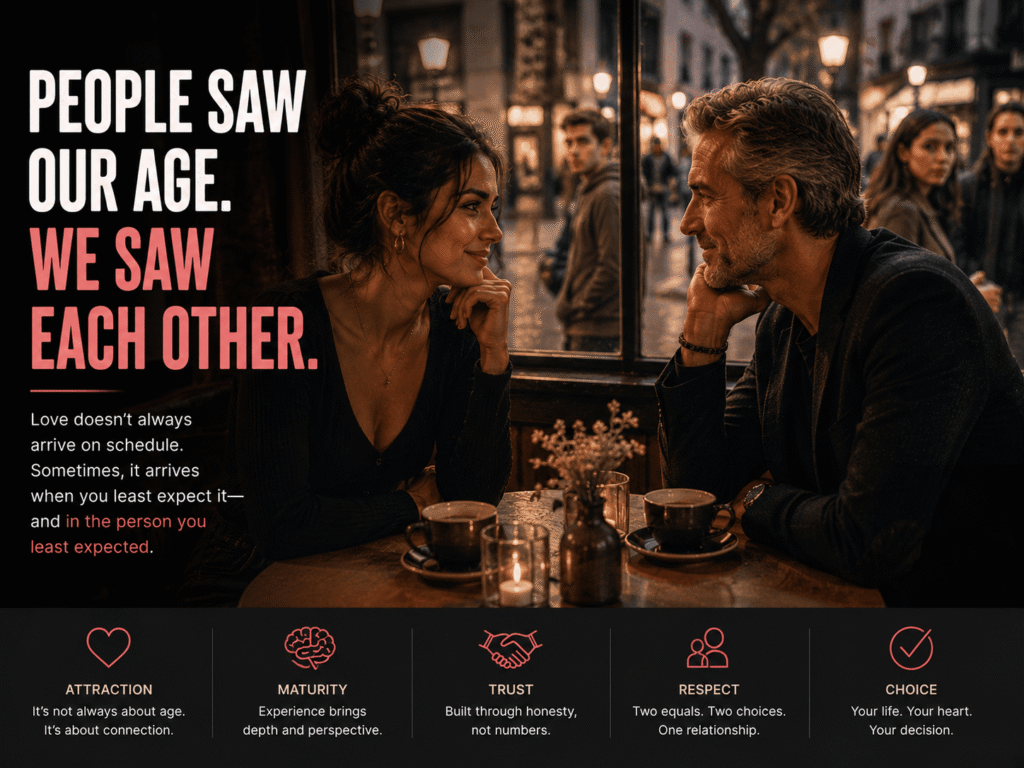
When Maya introduced her boyfriend to her friends, the room went unusually quiet. Nobody asked whether he was kind. Nobody wondered whether he respected her or made her laugh. The first question everyone asked was the same.
“Wait… isn’t he around your parents’ age?”
She smiled awkwardly because she had asked herself that question hundreds of times before anyone else did.
The truth was, she never planned to fall in love with someone twenty-five years older than her. It wasn’t a fantasy or a dating preference she had written into an app. They met through work. Conversations became coffee. Coffee became long walks. Somewhere between discussing books, careers, regrets, and childhood dreams, attraction quietly replaced curiosity. By the time she noticed it, it already felt real.
Age-gap relationships tend to make people uncomfortable because they force us to question assumptions about attraction. We like believing love follows neat social rules. Similar ages. Similar life stages. Similar expectations. When a couple breaks those patterns, people often search for hidden motives. One must be chasing money. The other must be avoiding maturity. Yet real relationships are rarely that easy to explain.
What attracts someone to an older partner is often less about age itself and more about what age represents. Confidence. Emotional steadiness. Patience. A person who listens instead of competing to speak. Someone who has survived enough failures to stop pretending they’re perfect. These qualities aren’t exclusive to older people, but they often become more common with experience. Sometimes we don’t fall for wrinkles or grey hair. We fall for the emotional calm that comes with them.
The opposite can also happen. An older person may be drawn to someone younger because they feel hopeful, spontaneous, curious, or emotionally alive. Healthy attraction is rarely about collecting trophies. It is about finding qualities that bring balance to our own lives.
That doesn’t mean every significant age-gap relationship is healthy.
Large differences in age can also create differences in power, financial independence, life experience, or emotional influence. A relationship deserves closer attention if one person consistently controls decisions, isolates the other from friends and family, or uses experience to silence disagreement. Those are warning signs regardless of whether the age gap is five years or thirty.
Maya kept asking herself one uncomfortable question.
“Do I love him, or do I love how safe he makes me feel?”
It took months before she realized those weren’t necessarily different questions.
The healthiest relationships don’t make us choose between excitement and safety. They create room for both. Feeling emotionally secure isn’t evidence that attraction is fake. Sometimes it is exactly what allows attraction to grow beyond the rush of uncertainty.
Psychologists often describe attraction as a mirror rather than a mystery. We are drawn toward qualities that satisfy emotional needs, reflect parts of ourselves, or represent the life we hope to build. For one person, that may be adventure. For another, stability. For someone else, wisdom. Age becomes one characteristic among many, not the entire explanation.
Of course, the outside world rarely sees it that way.
People stare.
Friends make jokes.
Families worry.
Strangers assume.
Some concerns come from genuine care. Others come from discomfort with relationships that challenge familiar expectations. Listening to thoughtful concerns can be valuable, but living your life according to every opinion eventually becomes impossible.
Months later, Maya asked her boyfriend why he thought they worked.
He laughed and said something she never forgot.
“You keep reminding me that life is still beginning. I remind you that it doesn’t have to be rushed.”
For the first time, she stopped thinking about numbers.
She started thinking about how she felt whenever they were together.
Age can influence a relationship.
It cannot define one.
The better questions are not “Is someone too old for me?” or “Will people approve?”
The better questions are these.
Do we respect each other?
Do we have equal freedom to disagree?
Can we imagine growing together instead of one person growing around the other?
Does this relationship make both of us more ourselves rather than less?
Those answers reveal far more than the number on a birthday cake ever will.
Sometimes love surprises us by arriving in an unexpected person.
What determines its future isn’t the age difference.
It’s the quality of the relationship the two people choose to build.
Love doesn’t always follow society’s expectations. Explore more editorials from Sex ‘N’ Cigarette on attraction, emotional intelligence, modern relationships, and the psychology behind why we love who we love.
Recommended Reads:
- Aarav Slept With Ex After Marriage And now In Guilt.
- The Moment You Lose Interest After Sex Says More About Desire Than Love.
- Dating Your Friend’s Ex: Is Love Worth Losing a Friendship?
- The Kamasutra Is More Than Sex. It’s a Guide to Love, Intimacy, and Life.
- Couple Games That Build Trust, Intimacy, and Better Communication
- 5 LGBTQ Leaders Who Changed How the World Sees Love