
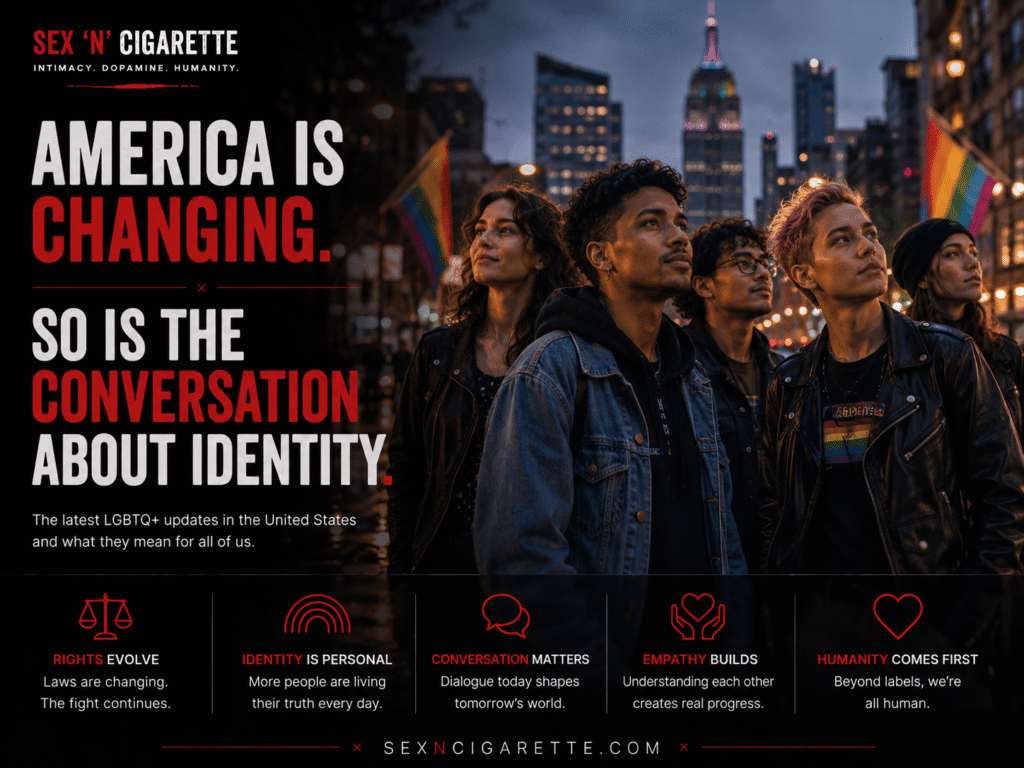
America’s conversation about LGBTQ+ identity has entered one of its most consequential chapters in decades.
Pride celebrations are still filling city streets. LGBTQ+ representation in entertainment remains stronger than ever. Younger generations continue to identify across a broader spectrum of sexual orientations and gender identities than any generation before them. Yet, at the same time, courtrooms, legislatures, schools, and families are debating questions that seemed unimaginable only a few years ago. Identity is no longer just a personal journey. It has become one of the defining cultural conversations of modern America.
One of the biggest developments came from the U.S. Supreme Court, which recently ruled that states may legally restrict transgender girls and women from participating in girls’ and women’s school sports. The decision does not require every state to adopt such restrictions, but it allows states to do so under current interpretations of Title IX and the Constitution. Supporters argue the ruling protects fairness in women’s sports, while critics believe it marks a significant setback for transgender inclusion. The debate continues far beyond the courtroom because it touches identity, fairness, biology, belonging, and human dignity all at once.
The legal landscape is shifting elsewhere as well. Advocacy organizations continue challenging restrictions on gender-affirming healthcare, while courts are hearing cases involving privacy, education, and access to medical treatment. At the same time, lawmakers across different states are pursuing very different approaches. Some states are expanding protections for LGBTQ+ people, while others are introducing new limitations. The result is an America where a person’s legal experience may differ dramatically depending on where they live.
Outside politics, something equally important is happening. Public conversations around identity have become more open than ever before. More people are asking questions they once kept hidden. Some are exploring bisexuality later in life. Others are discussing gender identity with their families for the first time. Social media has given millions of people language to describe feelings they never previously understood, even as it has intensified disagreement and misinformation. Identity today is shaped as much by TikTok, Reddit, podcasts, and online communities as it is by classrooms or traditional institutions.
Psychologists often remind us that identity development is rarely a straight line. Many people spend years questioning attraction, relationships, gender expression, or where they belong. That process isn’t new. What’s new is that those questions are now unfolding in public, amplified by algorithms, headlines, and political debates. For some people, that visibility creates hope. For others, it creates fear. Either way, it has become one of the defining emotional experiences of this generation.
Perhaps the biggest lesson isn’t about who wins the next legal battle. It’s about learning how to have conversations that don’t immediately become wars. Whether someone is LGBTQ+, questioning, an ally, or simply trying to understand a changing world, empathy remains more powerful than assumptions. Progress isn’t built only through legislation. It’s built every time someone chooses curiosity over contempt and conversation over condemnation.
The LGBTQ+ story in America is still being written.
And like every important chapter in history, it will be remembered not only for the laws that changed, but for how people chose to treat one another while those changes were happening.
Sex ‘N’ Cigarette explores intimacy, identity, psychology, modern relationships, and the cultural conversations shaping how we connect with each other.
Because understanding people is always more valuable than simply judging them.
Recommended Reads:
- How To Know If He’s Happy In Bed Without Asking Him
- These 5 Movies Didn’t Use Nudity To Shock You. They Used It To Tell Better Love Stories.
- Will She Come Back In My Life?
- Why Men Masturbate After Sex Even When They Love Their Partner
- Why Anonymous Sex Feels So Exciting, According To Psychology
- Why Men Obsess Over Being Better In Bed. It Has Less To Do With Sex Than You Think.