
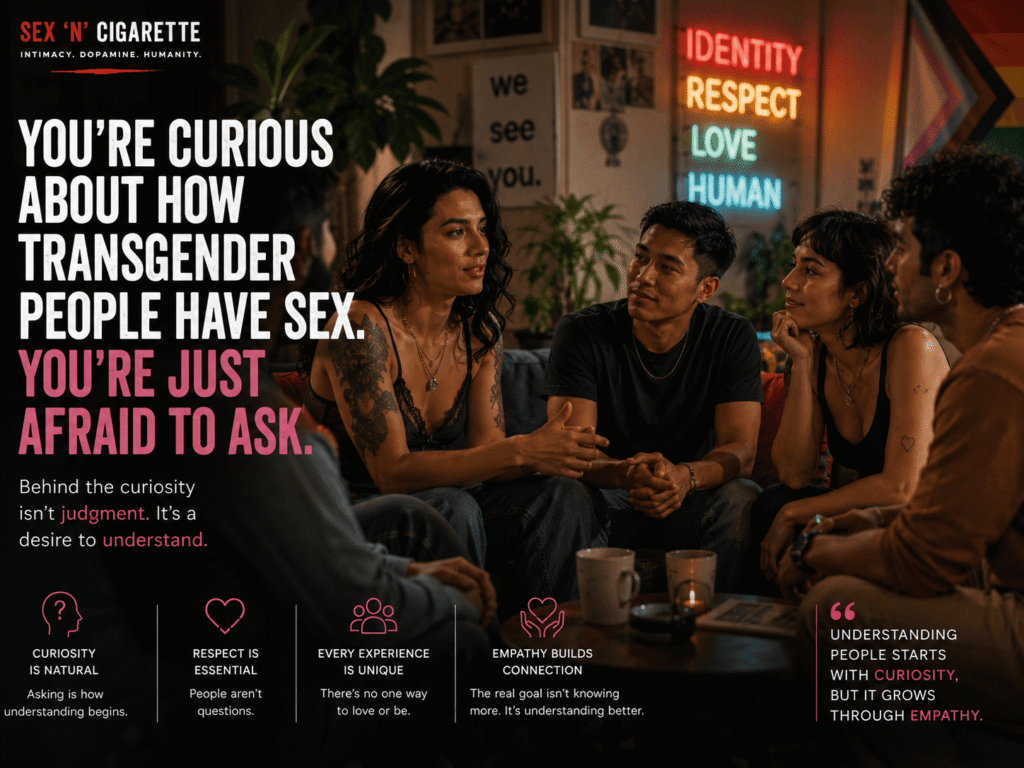
A friend asked me a question recently that millions of people have probably searched online at some point but very few feel comfortable saying out loud – “How do transgender people have sex?”
The moment the question left his mouth, he looked embarrassed. Not because he was trying to be offensive. Not because he was mocking anyone. Quite the opposite. He was genuinely curious and genuinely afraid of sounding disrespectful. That hesitation is interesting because it reveals something about the world we live in. People are often encouraged to be accepting of LGBTQ+ communities, but they’re rarely taught how to ask honest questions without feeling guilty. The result is a strange silence where curiosity exists everywhere, yet meaningful conversations almost never happen.
The first thing worth understanding is that there isn’t one universal answer. Human intimacy has never worked that way. Ask ten heterosexual couples about their sex lives and you’ll receive ten different answers. Ask ten gay couples and the same thing happens. The idea that all transgender people experience intimacy in a single identical way is one of the biggest misconceptions surrounding transgender identity. Being transgender describes a person’s gender identity. It doesn’t automatically describe how they experience attraction, relationships, romance, or sex. Just like everyone else, transgender people have different bodies, different preferences, different comfort levels, and different experiences.
What’s fascinating is how often curiosity about transgender intimacy is actually curiosity about gender itself. Most people grow up with relatively simple assumptions about men, women, relationships, and sexuality. Then they meet someone who doesn’t fit the script they were given as children. Suddenly they realize that human identity is far more diverse than they originally thought. The question isn’t really about sex anymore. It’s about understanding. It’s about trying to make sense of an experience outside their own. That’s not something to be ashamed of. Curiosity is often the first step toward empathy.
Unfortunately, the internet tends to make these conversations worse. On one side, you have people reducing transgender individuals to medical procedures and body parts. On the other side, you have people so afraid of saying the wrong thing that they avoid asking anything at all. Both approaches miss something important. Transgender people are not educational exhibits. They’re also not mysterious creatures whose experiences cannot be discussed. They’re human beings navigating attraction, intimacy, dating, relationships, heartbreak, and connection in many of the same ways everyone else does. The details may differ. The emotional experiences often don’t.
What surprised me most after talking with transgender friends over the years is how ordinary many of their relationship concerns sound. They worry about rejection. They worry about being understood. They worry about whether a new partner will accept them. They worry about vulnerability. In other words, they worry about the same things that keep countless straight, gay, bisexual, and queer people awake at night. Modern culture often becomes so focused on differences that it forgets to notice similarities. Behind every identity label is a person hoping to be desired, respected, and loved without constantly needing to justify their existence.
The deeper lesson here may have very little to do with transgender people specifically. It may have more to do with how we approach unfamiliar experiences. Curiosity isn’t the enemy of acceptance. In many cases, it’s the foundation of it. The problem isn’t asking questions. The problem is treating people like questions instead of people. When curiosity is combined with respect, conversations become possible. Understanding becomes possible. Human connection becomes possible.
Perhaps that’s why this topic generates so much interest. It sits at the intersection of sex, identity, attraction, and culture, four subjects that have fascinated human beings for centuries. But underneath all of those things is something surprisingly simple. Most people aren’t really searching for information about transgender sex. They’re searching for a better understanding of other human beings.
And honestly, that’s one of the healthiest reasons to be curious about anything.
If this article resonated with you, explore more conversations about sexuality, LGBTQ+ identity, intimacy, attraction, and modern human connection at Sex ‘N’ Cigarette.
Because understanding people starts with curiosity, but it grows through empathy.
Recommended Reads: