
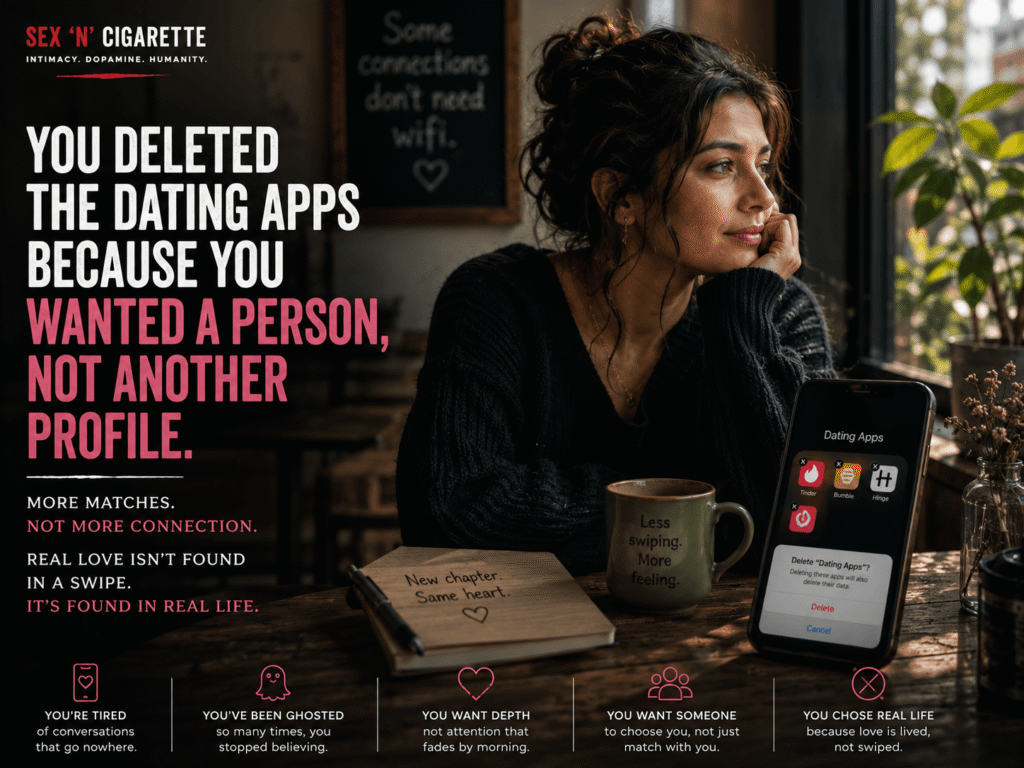
A Reddit post stopped me in the middle of my scrolling recently. Not because it was dramatic. Not because it was shocking. In fact, it was painfully ordinary, which is exactly what made it interesting. A woman in her early thirties wrote about deleting every dating apps from her phone. Tinder. Bumble. Hinge. Gone. She wasn’t swearing off relationships. She wasn’t announcing that love was dead. She wasn’t becoming cynical. She was simply tired. Tired in a way that thousands of people immediately understood. After years of matching, chatting, ghosting, restarting conversations, explaining herself, and trying to remain optimistic, she realized she was spending more time managing dating than actually connecting with anyone.
The most revealing part of her post wasn’t that she struggled to find matches. She had plenty of them. Her problem was something far more modern. Most of the people she met seemed to want access to intimacy without investing in connection. Conversations moved quickly toward flirting. Dates often felt like auditions for physical chemistry rather than opportunities to understand another person. The language of modern dating has become incredibly efficient. People discuss compatibility before vulnerability. Attraction before trust. Availability before curiosity. Somewhere along the way, many singles started feeling like products being evaluated instead of people being discovered.
What fascinated me was how many people in the comments shared the same experience. They weren’t angry at dating apps. They were exhausted by what dating apps had slowly trained them to become. Endless options sound exciting in theory. In practice, they often create a subtle emotional numbness. Every swipe carries possibility, but it also carries comparison. Every match arrives with the knowledge that another hundred profiles are waiting just one thumb movement away. Human beings were never designed to evaluate potential partners with the same behavior used to browse online shopping catalogs. Yet that’s exactly how modern dating sometimes feels. The result isn’t more romance. It’s often less investment.
The strange thing is that many people still genuinely want what this woman wanted. They want someone to ask meaningful questions. They want conversations that continue beyond midnight because both people forgot to check the time. They want attraction, of course, but they also want emotional safety. They want somebody who becomes a familiar part of their day. The problem is that these desires don’t always fit neatly inside the architecture of swipe culture. Dating apps are excellent at introducing people. They are less effective at teaching patience, depth, or emotional presence. Those qualities still require two people deciding that another human being deserves their full attention.
What I loved about her decision was that it wasn’t fueled by bitterness. She wasn’t rejecting technology. She wasn’t announcing that all men were the problem. She wasn’t claiming love no longer exists. Instead, she was choosing a different strategy. She wanted to meet people through friends. Through hobbies. Through ordinary life. Through situations where attraction grows alongside familiarity rather than appearing before it. In a culture obsessed with acceleration, there was something surprisingly rebellious about her decision to slow down. She was choosing uncertainty over endless options, depth over volume, and possibility over optimization.
This reminded me of something we rarely acknowledge. Some of the strongest relationships don’t begin with instant attraction. They begin with repeated exposure. Shared experiences. Unexpected conversations. A friendship that slowly becomes something else. Modern dating culture often treats chemistry as something that should arrive immediately, yet many lasting relationships were built long before somebody called them relationships. They were built through trust accumulating quietly in the background. That’s difficult to measure on a profile. It’s even harder to capture in six carefully chosen photos and a witty bio.
Maybe that’s why so many people feel conflicted about dating apps. They appreciate the convenience but miss the mystery. They enjoy the access but miss the anticipation. They have more opportunities to meet people than any previous generation, yet many still find themselves longing for something slower and more human. Not because they want less technology, but because they want more connection. The woman who deleted her apps wasn’t giving up on love. If anything, she was protecting her belief in it. She was refusing to let endless swiping convince her that meaningful relationships are outdated.
And perhaps that’s the most interesting part of the story. The moment she stopped looking for profiles, she started looking for people again. In a world where everybody is trying to be noticed, there is something incredibly attractive about someone who simply wants to be known.
If this article resonated with you, explore more conversations about attraction, dating culture, intimacy, emotional intelligence, and human connection at Sex ‘N’ Cigarette.
Because finding love isn’t always about meeting more people. Sometimes it’s about finding better ways to truly see them.
Recommended Reads: