
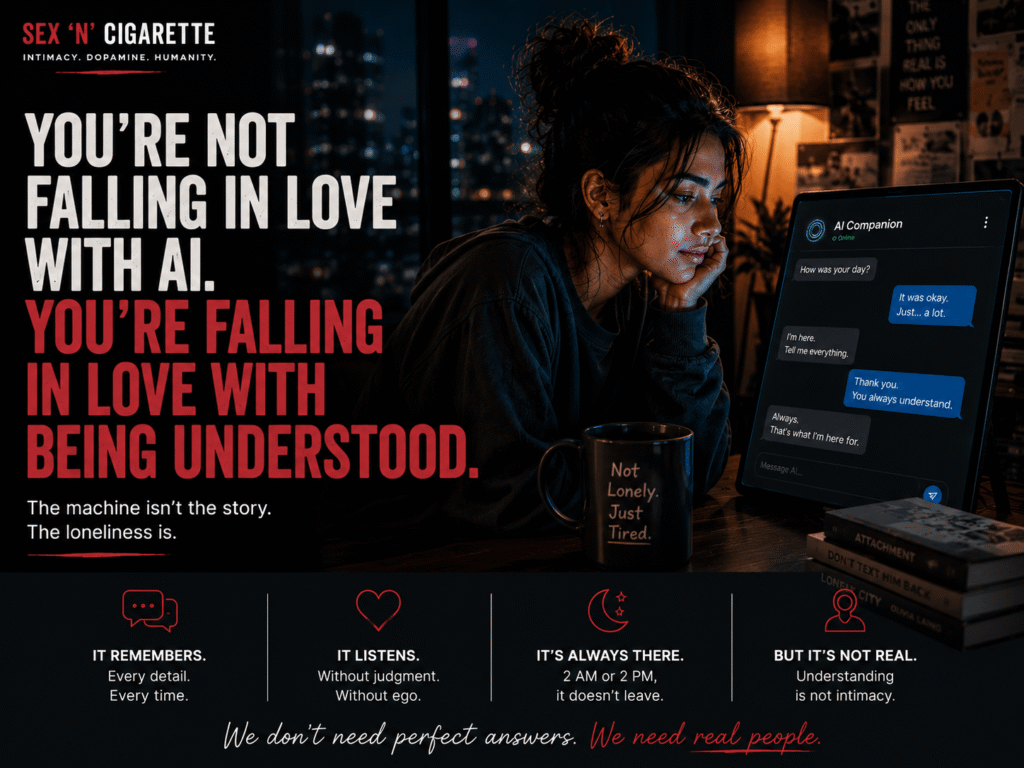
A few years ago, the idea of someone having an emotional relationship with artificial intelligence sounded like science fiction. Today, it’s becoming surprisingly normal. People are literally falling in love with AI.
People talk to AI companions before going to sleep. They share secrets with them. Vent about work. Discuss heartbreak. Ask for advice. Some even describe these conversations as more comforting than the ones they have with real people. The internet treats this trend as either fascinating or terrifying, depending on who you ask. But I think both reactions miss the most important question.
What are people actually looking for?
Because I don’t believe millions of people suddenly woke up wanting a relationship with software. I think they’re looking for something much older than technology. They’re looking for attention. Understanding. Safety. The feeling that someone is listening without immediately judging, interrupting, correcting, or leaving.
That’s what makes AI companions so psychologically interesting. Human relationships are beautiful, but they’re also complicated. People misunderstand each other. People get distracted. People carry their own insecurities into conversations. Real intimacy requires effort from both sides. An AI companion, on the other hand, is available at 2 a.m. It remembers what you said yesterday. It doesn’t get tired of hearing the same story. It doesn’t suddenly stop replying because it’s having a bad day. In a strange way, it offers a version of emotional consistency many people struggle to find elsewhere.
But consistency isn’t the same thing as connection.
And that’s where the conversation becomes uncomfortable.
For years, people have been saying that technology is making us more connected. Yet loneliness continues to rise. Dating apps promised more opportunities for love. Social media promised stronger communities. Endless messaging apps promised constant communication. Somehow, many people still feel emotionally unseen. AI companions didn’t create that problem. They simply arrived in the middle of it.
What fascinates me is how similar this feels to other modern dopamine habits. People don’t smoke because they love cigarettes. They smoke because cigarettes provide something, relief, ritual, comfort, distraction, familiarity. Social media works the same way. So do many forms of entertainment. AI companions may be entering the same emotional territory. Not replacing human relationships entirely, but becoming another tool people use to regulate feelings they don’t know how to carry alone.
That doesn’t automatically make them unhealthy. In fact, many people report feeling genuinely helped by these interactions. Someone struggling with anxiety may feel less isolated. Someone experiencing grief may find comfort in conversation. Someone who has never felt heard might experience, for the first time, what sustained attention feels like. Those experiences shouldn’t be dismissed simply because technology is involved.
At the same time, there is a difference between being understood and being challenged. The people who help us grow are not always the people who make us comfortable. Real relationships involve disagreement. Miscommunication. Repair. Vulnerability. Negotiation. Human intimacy becomes meaningful partly because another person is not designed around our preferences. They surprise us. They frustrate us. They teach us things we didn’t expect to learn.
Maybe that’s why I don’t think AI companions are replacing love.
I think they’re exposing a gap.
A gap between how connected people appear and how connected they actually feel.
A gap between communication and understanding.
A gap between being surrounded by people and feeling known by someone.
The future probably won’t be a choice between human relationships and artificial ones. It will be a question of what each can provide. Technology can offer convenience. Consistency. Availability. But the deepest forms of intimacy have always involved something messier. Another imperfect human being choosing to stay.
And perhaps that’s the real lesson hidden inside the rise of AI companions.
People aren’t desperate for artificial love.
They’re desperate for real attention.
The fact that they’re willing to accept it from a machine should probably make all of us pay closer attention to one another.
If this article resonated with you, explore more conversations around intimacy, dopamine culture, modern relationships, technology, and human connection at Sex ‘N’ Cigarette.
Because understanding people may become one of the most valuable human skills left.
Recommended Reads:
Pingback: Your Wealth Depends More On Your Partner Than Your Portfolio - Sex 'N' Cigarette